
Space engineering
Propulsion general requirements
Foreword
This Standard is one of the series of ECSS Standards intended to be applied together for the management, engineering and product assurance in space projects and applications. ECSS is a cooperative effort of the European Space Agency, national space agencies and European industry associations for the purpose of developing and maintaining common standards. Requirements in this Standard are defined in terms of what shall be accomplished, rather than in terms of how to organize and perform the necessary work. This allows existing organizational structures and methods to be applied where they are effective, and for the structures and methods to evolve as necessary without rewriting the standards.
This Standard has been prepared by the ECSS-E-ST-35 Working Group, reviewed by the ECSS Executive Secretariat and approved by the ECSS Technical Authority.
Disclaimer
ECSS does not provide any warranty whatsoever, whether expressed, implied, or statutory, including, but not limited to, any warranty of merchantability or fitness for a particular purpose or any warranty that the contents of the item are error-free. In no respect shall ECSS incur any liability for any damages, including, but not limited to, direct, indirect, special, or consequential damages arising out of, resulting from, or in any way connected to the use of this Standard, whether or not based upon warranty, business agreement, tort, or otherwise; whether or not injury was sustained by persons or property or otherwise; and whether or not loss was sustained from, or arose out of, the results of, the item, or any services that may be provided by ECSS.
Published by: ESA Requirements and Standards Division
ESTEC, ,
2200 AG Noordwijk
The
Copyright: 2009 © by the European Space Agency for the members of ECSS
Change log
|
ECSS-E-ST-35A
|
Never issued
|
|
ECSS-E-ST-35B
|
Never issued
|
|
ECSS-E-ST-35C
|
First issue
|
|
ECSS-E-ST-35C Rev. 1
|
First issue revision 1
|
Introduction
The requirements in this Standard (ECSS-E-ST-35) and in the three space propulsion standards dedicated to particular type of propulsion (ECSS-E-ST-35-01, ECSS-E-ST-35-02 and ECSS-E-ST-35-03) are organized with a typical structure as follows:
Functional
Constraints
Interfaces
Design
GSE
Materials
Verification
Production and manufacturing
In–service (operation and disposal)
Deliverables.
All the normative references, terms, definitions, abbreviated terms, symbols and DRDs of the ECSS Propulsion standards are collected in this ECSS-E-ST-35 standard.
The ECSS Propulsion standards structure is as follows.
ECSS-E-ST-35 Propulsion general requirements
Standards, covering particular type of propulsion
ECSS-E-ST-35-01 Liquid and electric propulsion for spacecrafts
ECSS-E-ST-35-02 Solid propulsion for spacecrafts and launchers
ECSS-E-ST-35-03 Liquid propulsion for launchers.
Standard covering particular propulsion aspects
ECSS-E-ST-35-06 Cleanliness requirements for spacecraft propulsion hardware
ECSS-E-ST-35-10 Compatibility testing for liquid propulsion systems
Further information on the use of conventional propellants, pressurants, simulants and cleaning agents is given in Annex M.
Scope
This Standard defines the regulatory aspects that apply to the elements and processes of liquid propulsion for launch vehicles and spacecraft, solid propulsion for launch vehicles and spacecraft and electric propulsion for spacecraft. The common requirements for the three types of space propulsion are written in the ECSS-E-ST-35 document. The specific requirements for each type of propulsion are given in ECSS-E-ST-35-01, ECSS-E-ST-35-02 and ECSS-E-ST-35-03. It specifies the activities to be performed in the engineering of these propulsion systems and their applicability. It defines the requirement for the engineering aspects such as functional, physical, environmental, quality factors, operational and verification.
Other forms of propulsion (e.g. nuclear, nuclear–electric, solar–thermal and hybrid propulsion) are not presently covered in this issue of the Standard.
This standard applies to all types of space propulsion systems used in space applications, including:
Liquid and electric propulsion for spacecraft.
Solid propulsion for launch vehicles and spacecraft;
Liquid propulsion for launch vehicles.
This standard may be tailored for the specific characteristic and constrains of a space project in conformance with ECSS-S-ST-00.
Normative references
The following normative documents contain provisions which, through reference in this text, constitute provisions of this ECSS Standard. For dated references, subsequent amendments to, or revision of any of these publications do not apply, However, parties to agreements based on this ECSS Standard are encouraged to investigate the possibility of applying the more recent editions of the normative documents indicated below. For undated references, the latest edition of the publication referred to applies.
|
ECSS-S-ST-00-01
|
ECSS system – Glossary of terms
|
|
ECSS-E-ST-10
|
Space engineering – System engineering general requirements
|
|
ECSS-E-ST-10-02
|
Space engineering – Verification
|
|
ECSS-E-ST-35-06
|
Space engineering – Cleanliness requirements for spacecraft propulsion hardware
|
|
ECSS-E-ST-31
|
Space engineering – Thermal control general requirements
|
|
ECSS-E-ST-32
|
Space engineering – Structural general requirements
|
Terms, definitions and abbreviated terms
Terms defined in other standards
For the purpose of this Standard, the terms and definitions from ECSS-S-ST-00-01 apply.
For the purpose of this Standard, the following definitions from ECSS-E-ST-10 apply:
technology readiness level (TRL)
For the purpose of this Standard, the following definitions from ECSS-E-ST-32 apply:
MDP
MEOP
mission life
Terms specific to the present standard
General terms
ablated thickness
removed thickness of thermal protection material, due to thermal and mechanical loads, during combustion duration
Mathematically called “ea”
barbecue mode
mode where a stage or spacecraft slowly rotates in space in order to obtain an even temperature distribution under solar radiation
beam divergence
semi–angle of a cone, passing through the thruster exit, containing a certain percentage of the current of an ion beam at a certain distance of that thruster exit
buffeting
fluctuating external aerodynamic loads due to vortex shedding
burning time, tb
time for which the propulsion system delivers a thurst
Figure 31 illustrates an arbitrary thrust or pressure history of a rocket propulsion system. An igniter peak can, but need not, be observed.Depending on the application, a time, t0, is defined at which the propulsion system is assumed to deliver a thrust, and a time, te, at which the propulsion system is assumed not to deliver an thrust any more. The burning time is the time interval defined as the difference between the two times: tb=te – t0.
 Figure 31 Burning time
characteristic velocity, C*
<instantaneous characteristic velocity> ratio of the product of the throat area of a rocket engine and the total pressure (at the throat) and the propellants mass flow rate
- 1 In accordance with this definition, the instantaneous characteristic velocity is:

- 2 Instantaneous and overall characteristic velocities are usually referred to as characteristic velocity.
- 3 The usual units are m/s.
characteristic velocity, C*
<overall characteristic velocity> ratio of the time integral of the product of throat area and total pressure (at the throat) and the propellants ejected mass during the same time interval
-
1 In accordance with this definition, the overall characteristic velocity is:
 In many cases t1 is taken to be the ignition time, t0, and t2 is taken to be the time at burnout (te). In that case, t2 - t1 = tb and the integral in the denominator equals the ejected mass.
 -
2 Instantaneous and overall characteristic velocities are usually referred to as characteristic velocity.
-
3 The usual units are m/s.
charred thickness
remaining thermal material thickness after motor operating, affected by thermal loads
- 1 For example, composition evolution.
- 2 Mathematically, it is called “ec”
chill–down
process of cooling the engine system components before ignition in order to reach specific functional and mechanical criteria (e.g. the propellants proper thermodynamic state)
component
smallest individual functional unit considered in a subsystem
For example tanks, valves and regulators.
contaminant
undesired material present in the propulsion system at any time of its life
corridor
variation envelope of a time dependent parameter
critical speed
speed at which the eigenfrequency of the rotor coincides with an integer multiple of the rotational speed
cryo–pumping
condensation of gas on cryogenic fluid (e.g. LH2, LHe ) lines or components, thereby sucking in more gas and thereby preventing normal operation of cryogenic system
For example, preventing proper chill–down.
de–orbiting
controlled return to Earth or other celestial body or burn–up in the atmosphere of a spacecraft or stage
dimensioning
process by which the dimensions of an entity (system, subsystem or component) is determined and verified, such that the entity conforms to the entity requirements and can withstand all loads during its mission
Dimensioning is only possible after the sizing process for the particular system or subsystem has been completed.
dimensioning case
set of loads combinations which have been identified by failure modes analysis
discharge coefficient, Cd
<for nozzle> inverse of the characteristic velocity
- 1 In accordance with this definition, the discharge coefficient is

- 2 In this Standard, the units are s/m.
- 3 Also called mass flow rate coefficient
draining
emptying the fluid contents from a volume
electric thruster
propulsion device that uses electrical power to generate or increase thrust
engine inlet pressure
propellant stagnation pressure at the engine inlet
envelope
set of physical data in which the propulsion system, subsystem, or component is intended to operate
- 1 It is also called domain.
- 2 For propulsion systems, the concept of operational envelope is applied in the design. The concept of extreme envelope is commonly used for liquid propulsion for launchers (see ECSS-E-ST-35-03).
erosive burning
increase of the solid burning rate of the propellant due to high gas velocities parallel to the burning surface
fluid hammer
see water hammer (see 3.2.1.88).
flushing
passing a fluid through a volume with the objective of removing any remains of other fluids in this volume
flutter
aero–elastic instability
functional transducer
transducer used as an input for controlling the system in real time
graveyard orbit
orbit about 300 km or more above a GEO or GSO into which spent upper stages or satellites are injected to reduce the creation of debris in GEO or GSO
ground support equipment GSE
equipment adapted to support verification testing and launch preparation activities on the propulsion system
hump effect
effect by which the solid propellant burning rate varies with the penetration depth into the propellant grain
hypergolic propellants
propellants which spontaneously ignite upon contact with each other
ignition time, tign
<for solid propulsion> time at which the solid motor pressure has reached a given percentage of the theoretical pressure corresponding to the combustion of the main propellant grain only (explicitly excluding the igniter peak)
impulse bit
time integral of the force delivered by a thruster during a defined time interval
Impulse bit is expressed in Ns.
initiator
first element in an explosive chain that, upon receipt of the proper impulse, produces a deflagrating or detonating action
The impulse can be provided by mechanical, electrical, optical action.
insulation thickness (ej)
thickness of non affected material to ensure a given interface temperature
interface
common boundary involving a direct interaction between two or more systems, subsystems or components
launch vehicle
vehicle intended to move a spacecraft from ground to orbit or between orbits
limit testing
determining experimentally the operating limit under which a system, subsystem, component or material can be used without loss of integrity or loss of functional capability
liquid rocket engine
chemical rocket motor using only liquid propellants
This includes catalytic bed monopropellant engine.
minimum impulse bit
smallest impulse delivered by a thruster at a given level of reproducibility, as a result of a given command
Minimum impulse bit is expressed in Ns.
mission
see mission life (see 3.1)
The mission encompasses the complete life of the propulsion system or subsystem: delivery, (incoming) inspection, tests, storage, transport, handling, integration, loading, pre–launch activities, launch, in–orbit life, passivation and, if applicable, disposal.
mixture ratio
ratio of oxidizer to fuel mass flow rates
non affected thickness(es)
remaining thermal protection material thickness after solid motor operating, non affected by thermal and mechanical loads
nozzle
Device to accelerate fluids from a rocket motor to exhaust velocity
net positive suction pressure NPSP
difference between the total pressure and the vapour pressure at a given temperature
- 1 In accordance with this definition, NPSP = ptot – pvap(T).
- 2 There are 3 types of NPSPs (see Figure 32):
- NPSPavailable which is the NPSP at a given instant and at a certain location.
- NPSPcr, or critical NPSP which is the NPSP below which the pump pressure rise decreases below a pre defined value due to cavitation.
- NPSPreq, or required NPSP which is NPSPreq = NPSPcr + safety margin.
In accordance with these definitions, NPSPcr < NPSPavailable
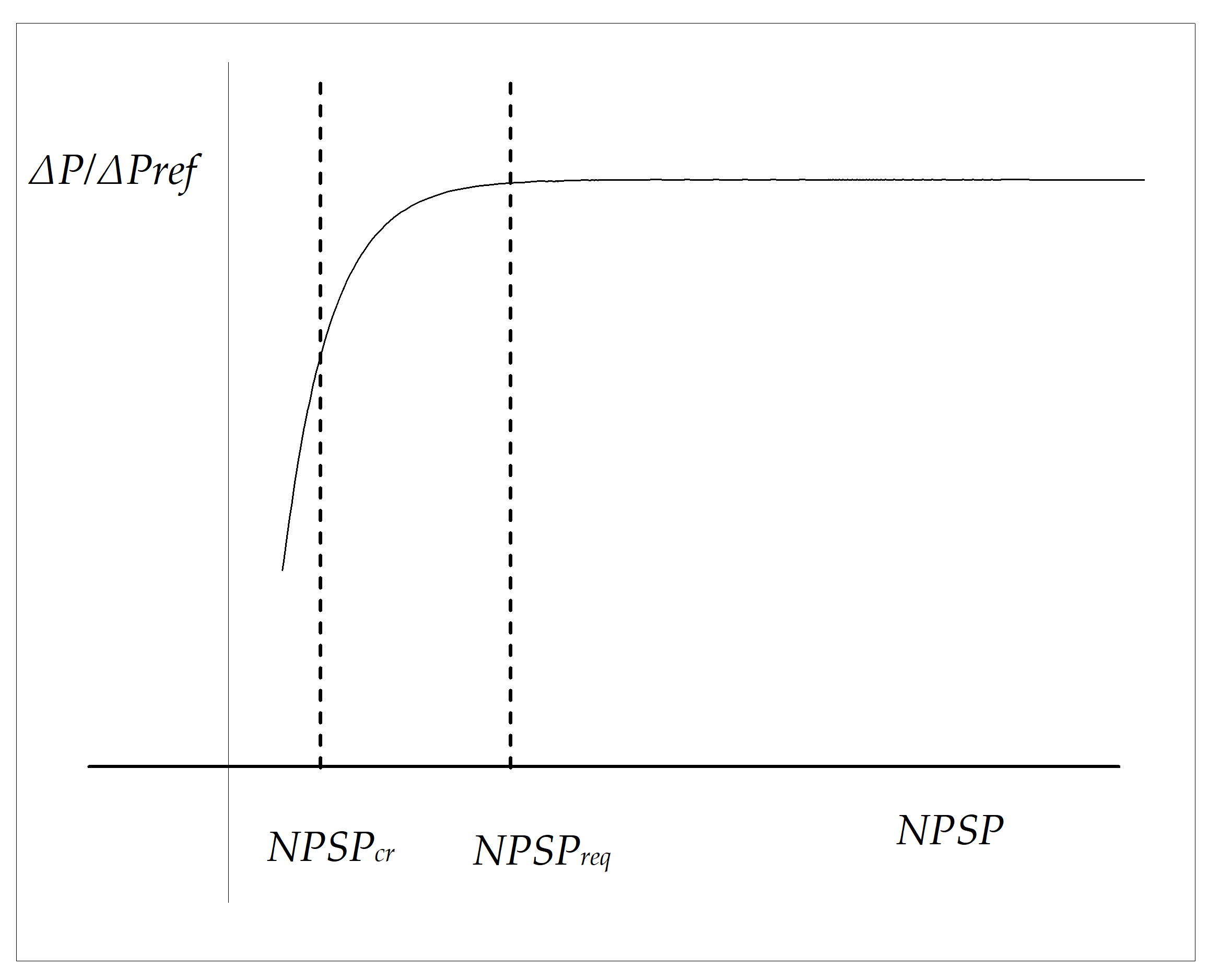 Figure 32: NPSP
plasma
ionized gas
Plasma contains neutral species, ions and electrons.
POGO
coupling between the dynamic behaviour of the launcher structure and a fluctuating thrust, resulting in a fluctuation of the mass flow rate at the engine inlet
pre–heating time
time that the thermal protection is exposed to the combustion gases in the “dead water” zone
The floater (see Figure 33) is assumed to be consumed by the combustion products roughly at the same rate as the propellant regresses. Between the remaining floater and the thermal protection, a “dead water” zone of combustion products exists. Because of the relatively low gas velocity in this “dead water” zone, the heat transfer to the thermal protection is reduced to conduction and radiation only.
 Figure 33 Relief flap or floater
pressurant
fluid used to pressurize a system or subsystem
pressure drop coefficient
coefficient which expresses the pressure drop over a component
The pressure drop coefficient is usually represented by k, and in accordance with this definition k=p/S for instance.
priming
filling operation of a fluid volume as a first step of operation
propellant
material or materials that constitute a mass which, often modified from its original state, is ejected from a propulsion device to produce thrust
propellant gauging
determination of the remaining propellant on board at a given time in the mission.
propulsion system
system to provide thrust
- 1 In this standard it is also referred to as the system.
- 2 Propulsion system comprises all components used in the fulfilment of a mission, e.g. thrusters, propellants, valves, filters, pyrotechnic devices, pressurization subsystems, feeding system, tanks and electrical components.
- 3 Electrical power sources are only included in Electrical propulsion system.
purging
removing fluid from a volume containing liquid and gas
pyrogen igniter
igniter for a (solid) rocket motor producing a heat flux and a flux of hot gases, and that builds up pressure under its own action
pyrotechnic igniter
igniter for a (solid) rocket motor that primarily produces a heat flux of hot particles but hardly builds up pressure under its own action
repeatability
ability to repeat an event with the same input commands
required factor, Kr
<solid propulsion> factor of safety used for mechanical dimensioning of visco elastic or non linear behaviour materials
re-orbiting
injection of a spacecraft or stage into a graveyard orbit
simulant
fluid replacing an operational fluid for specific test purposes
- 1 The simulant is selected such that its characteristics closely resemble the characteristics of the operational fluid whose effects are being evaluated in the system, subsystem or component test.
- 2 The simulant is selected such that it conforms to the compatibility requirements of the system, subsystem or component.
side load
lateral force on a nozzle during transient operation due to asymmetric plume
sizing
process by which the overall characteristics of a system or subsystem are determined during the conceptual phase of the design
At the end of the sizing process, functional and material characteristics are also established. The sizing process conforms to the functional requirements.
solid rocket motor
chemical rocket motor using only solid propellants
spacecraft
vehicle purposely delivered by the upper stage of a launch vehicle or transfer vehicle
For example, satellite, ballistic probe, re–entry vehicle, space probes and space stations.
specific impulse, ISP
<instantaneous specific impulse> ratio of thrust to mass flow rate
- 1 The specific impulse is expressed in Ns/kg or m/s.
- 2 In engineering, another definition is often still used where the specific impulse is defined as the ratio of thrust to weight flow rate. This leads to an Isp in seconds (s). The numerical value of Isp (s) is obtained by dividing the Isp expressed in m/s by the standard surface gravity, g0 = 9,806 65 m/s2.
specific impulse, ISP
<average specific impulse> ratio of total impulse and total propellant ejected mass in the same time interval used for the establishment of the total impulse
See notes for 3.2.1.66 “specific impulse”.
subsystem
set of independent elements combined to achieve a given objective by performing a specific function
- 1 See ECSS-S-ST-00-01 ‘subsystem’.
- 2 For example: tanks, filters, valves and regulators constitute a propellant feed subsystem in a propulsion system.
system
See propulsion system (see 3.2.1.54).
termination point
location, in a bonding application, where the local stress is multi–directional due to a geometric discontinuity
It can also be referred to as triple point (see 3.2.1.82).
throttling
adjustment of the thrust level using control devices
thrust
generated force due to acceleration and ejection of matter
thrust centroid time
time at which an impulse, of the same magnitude as the impulse bit, is applied, to have the same effect as the original impulse bit
thrust chamber assembly (TCA)
assembly of one or more injectors, igniters, combustion chambers, coolant systems and nozzles
There are concepts where one engine has more than one combustion chamber, e.g. a modular plug nozzle engine.
thrust coefficient, CF
<instantaneous thrust coefficient> ratio of (instantaneous) thrust and the product of throat area and throat total pressure
- 1 In accordance with this definition, the instantaneous thrust coefficient can be calculated as:

- 2 Instantaneous and average thrust coefficients are usually referred to as thrust coefficient.
thrust coefficient, CF
<average thrust coefficient > ratio of the thrust integrated over an appropriate time interval divided by the integral over the same time interval of the product of throat area and throat total pressure
-
1 In accordance with this definition, the average thrust coefficient can be calculated as:
 In many cases, t1 is taken to be the ignition time, t0,and t2 is taken the time at burnout (te). In this case, t2 - t1 = tb and the integral of the thrust becomes the total impulse.
 -
2 Instantaneous and average thrust coefficients are usually referred to as thrust coefficient.
thrust misalignment
difference between the real and intended direction of the thrust vector
thrust out–centring
thrust vector not passing through the instantaneous COM
thrust vector control
sub system used to adjust the direction of the thrust vector on command
total impulse
time integral of the force delivered by a thruster or a propulsion system during the operational time interval
Total impulse is expressed in Ns.
trimming
adjustment of the operating point (mixture ratio and thrust level) using control devices
triple point
<for solid motor> See termination point (see 3.2.1.70).
In this Standard, triple point only refers to thermal protection.
turbo pump
device in a rocket motor consisting of a turbine driven by a high energy fluid, driving one or more rotating pumps in order to deliver specific ranges of fluid mass flow rates at specified ranges of pressure
ullage volume
volume in a tank not occupied by liquid propellant and equipment and lines present in the tank
valve manoeuvring time
moving time of the valve between an initial predetermined position and a final predetermined position
valve response time
time between the command given to the valve to move and the initial movement of the valve
venting
opening a closed volume to the ambient with the objective of decreasing the pressure in the volume
water hammer
pressure surge or wave caused by the kinetic energy of a fluid in motion when it is forced to stop or change direction suddenly
This is also generically indicated as fluid hammer (see 3.2.1.24)
Definition of masses
dry mass
initial mass without loaded mass
end of flight or final mass
mass of the propulsion system directly after the end of the propulsion system operation
ejected mass
difference between the initial mass and the end of flight mass
initial mass
total propulsion system mass just before activation
loaded mass
sum of propellants mass, pressurant mass and mass of (other) fluids just before activation of the propulsion system
propellant mass
sum of the mass of the main propellant, the gas generator and starter propellants, the propellants for attitude control, and the igniter propellants
residual mass
propellants mass that remains in the propulsion system at the end of operation
Abbreviated terms
The following abbreviated terms are defined and used within this Standard:
|
Abbreviation
|
Meaning
|
|
AIV
|
assembly, integration and verification
|
|
ACS
|
attitude control system
|
|
AOCS
|
attitude and orbit control system
|
|
BOL
|
beginning-of-life
|
|
CEX
|
charge exchange
|
|
CFC
|
chloro fluoro carbons
|
|
CFD
|
computational fluid dynamics
|
|
COM
|
centre of mass
|
|
CPIA
|
chemical propulsion information agency
|
|
DDF
|
design and definition file
|
|
DF
|
definition file
|
|
DJ
|
justification file
|
|
DJF
|
design and justification file
|
|
DLAT
|
destructive lot acceptance test
|
|
DRD
|
document requirements definition
|
|
EIDP
|
end item data package
|
|
EJMA
|
expansion joints manufacturer association
|
|
EMC
|
electromagnetic compatibility
|
|
EMI
|
electromagnetic interference
|
|
EOL
|
end–of–life
|
|
EP
|
electric propulsion
|
|
FEEP
|
field emission electric propulsion
|
|
FMECA
|
failure modes, effects and criticality analysis
|
|
FOS
|
factor of safety
|
|
GEO
|
geostationary orbit
|
|
GSE
|
ground support equipment
|
|
GSO
|
geosynchronous orbit
|
|
IATA
|
international air transport association
|
|
LOx
|
liquid oxygen
|
|
MDP
|
maximum design pressure
|
|
MEOP
|
maximum expected operating pressure
|
|
MLI
|
multi layer insulation
|
|
MMH
|
monomethyl hydrazine
|
|
MON
|
mixed oxides of nitrogen
|
|
MPD
|
magneto–plasma–dynamic thruster
|
|
NDI
|
non-destructive inspection
|
|
NPSP
|
net positive suction pressure
|
|
NTO
|
nitrogen tetroxide
|
|
OBC
|
on–board computer
|
|
OBDH
|
on–board data handling
|
|
ODE
|
one-dimensional equilibrium
|
|
PACT
|
power augmented catalytic thruster
|
|
PCU
|
power conditioning unit
|
|
PED
|
positive expulsion device
|
|
PMD
|
propellant management device
|
|
PPT
|
pulsed plasma thruster
|
|
RAMS
|
reliability, availability, maintenance and safety
|
|
RCS
|
reaction control system
|
|
RFNA
|
red fuming nitric acid
|
|
SRM
|
solid rocket motor
|
|
STD
|
surface tension device
|
|
TBI
|
through bulkhead initiator
|
|
TBPM
|
to be provided by manufacturer
|
|
TBPU
|
to be provided by user
|
|
TCA
|
thrust chamber assembly
|
|
TEG
|
turbine exhaust gases
|
|
TM/TC
|
telemetry/telecommand
|
|
TRL
|
Technology readiness level
|
|
TS
|
Technical Specification
|
|
TVC
|
thrust vector control
|
|
UDMH
|
unsymmetrical-dimethylhydrazine
|
|
VCD
|
verification control document
|
Symbols
The following symbols are defined and used within this Standard:
|
Symbol
|
Meaning
|
|
ae
|
half nozzle cone angle (at exit)
|
|
b
|
thrust deflection angle (for TVC)
|
|
C*
|
characteristic velocity
|
|
C
|
discharge coefficient
|
|
CF
|
thrust coefficient
|
|
D
|
diameter
|
|
|
increment
|
|
F
|
thrust
|
|
f
|
frequency
|
|
F
|
mixture ratio, ratio of oxidizer and fuel mass flow rate
|
|
g0
|
standard Earth surface gravity, 9,806 65 m/s2
|
|
h
|
enthalpy
|
|
Isp
|
specific impulse
|
|
k
|
pressure drop coefficient
|
|
L
|
length
|
|
L*
|
characteristic length of a combustion chamber
|
|
l
|
correction factor for divergence loss
|
|
m
|
mass flow rate
|
|
Mp
|
total expelled mass
|
|
M0
|
initial mass of a propulsion system
|
|
Mf
|
mass of the propulsion system at end of motor operation
|
|
n-D
|
(n is 1,2 or 3) n-dimensional
|
|
pmax
|
maximum pressure due to ignition
|
|
pvap
|
vapour pressure
|
|
S
|
surface area or cross section area
|
|
sN
|
normal stress at the interface of a bond
|
|
T
|
temperature
|
|
T
|
torque (pumps and turbines)
|
|
tb
|
burning time
|
|
ti
|
time at which combustion starts
|
|
tign
|
ignition time
|
|
t
|
shear stress at the interface of a bond
|
|
DV
|
ideal velocity increment of a rocket delivered in a gravitation free environment and without other disturbing forces (drag, solar wind, radiation pressure)
|
|
w
|
rotational speed
|
|
( )eff |
effective
|
Propulsion engineering activities
Overview
Relationship with other standards
For the propulsion quality assurance system, see ECSS-ST-Q-20.
For safety requirements see ECSS-Q-ST-40.
For mechanical aspects, structural design and verification of pressurized hardware, see ECSS-E-ST-32-02.
For space environment, see ECSS-E-ST-10-04.
For radiation, see ECSS-E-ST-10-12.
For shock, see ECSS-E-ST-32 and ECSS-HB-32-25.
For mechanism, see ECSS-E-ST-33-01, ECSS-E-ST-35-01, ECSS-E-ST-35-02 and ECSS-E-ST-35-03.
For pyrotechnics devices, see ECSS-E-ST-33-11.
Characteristics of propulsion systems
The specification, design and development of a propulsion system should be always done in close collaboration between those responsible for the system and those responsible for the propulsion engineering.
Propulsion systems have the following characteristics:
They provide the specified thrust.
They use materials (propellants, simulants and cleaning agents) that can be toxic, corrosive, highly reactive, flammable, and dangerous with direct contact (e.g. causing burns, poisoning, health hazards or explosions). The criteria for the choice and use of material are covered by ECSS-E-ST-32-08.
Handling, transportation and disposal of dangerous or toxic materials and fluids is subject to strictly applied local regulations.
Risks (e.g. contamination and leakages) are properly analysed and covered, and RAMS studies are widely performed.
Rocket engines can be subject to instabilities which can result in damage or loss of the motor or the vehicle. Design and development includes the definition of solutions at the system and vehicle level.
The propulsion system shall conform to the mission requirements described in the propulsion system technical specification, including:
- Ground operations (i.e. functional control, testing, propellant, simulant loading and transportation).
- Pre–launch and launch activities (i.e. integration, storage, ageing and transport).
- In–orbit operations (i.e. orbit transfer, orbit maintenance and attitude control) and the complete in-orbit life.
- Disposal operations.
Development
The safety requirements shall be specified for the Preliminary Design Review.
- 1 For example, requirements related to risks of human casualties, launch pad destruction, test facility destruction.
- 2 For development phases see ECSS-M-ST-10, Project planning and implementation.
During the development the following shall be established and documented: - All characteristics of the system, subsystems and components.
- The manufacturing and control processes.
The objective is to reach a product satisfying the maximum product–to–product variation limit, while conforming to the functional, performance and system requirements (see 4.3g).
To establish and freeze the design, the following shall be done:
- To perform the sizing process.
- To establish the verification models.
The tests, analysis and engineering activities should cover all possible failure modes.
The characteristics of the propulsion system and its equipment shall be established from analyses, characterization of materials, test results and correlation with models.
The critical technologies, manufacturing and control processes shall be identified, described, justified and subject to a qualification plan.
It shall be analysed that the manufacturing and control processes lead to products that satisfy the required product–to–product deviation limit.
For complex systems, conformity to this requirement can be demonstrated only after a large number of units are produced.
System verification shall be performed by both analysis and tests.
The level of testing shall be justified and submitted for customer approval.
The level of testing include:
- The level of configuration: at equipment, subsystem or system level
- The representativeness of the mission and environment constraints
- The represetativeness of the propellants
When verification at system level is performed by test, a representative propulsion system, including electrical system, shall be tested in flight conditions or flight representative conditions.
The differences between system test conditions and flight conditions shall be identified, assessed and documented in DJF.
Margins shall be determined and documented.
Where knowledge of margins cannot be obtained by analyses and standard tests, materials, components and subsystems are submitted to limit testing.
Propulsion system interfaces
Interface characteristics between the propulsion system and the space vehicle (spacecraft or launch vehicle) shall be accounted for in the requirements for the propulsion system.
Interface characteristics amongst the components, sub-systems and the propulsion system shall be accounted for in the respective requirements.
Interfaces identified in 4.4b shall include:
- Geometry, including the analysis of the dimensions for all phases of life.
For example, assembly, transport, and flight.
- Mechanical, including induced loads, static and dynamic.
- Fluids, including propellants and venting.
- Thermal boundary conditions.
- Electrical functions, including electrical continuity when applicable.
- Materials.
Design
General
When developing a product intended for production use, only mature technologies with TRL higher or equal to 5 shall be used.
If requirement 4.5.1a is not met, the technologies with TRL lower than 5 shall:
- Be subjected to a risk analysis.
- Lead to a dedicated maturation plan to be applied.
The propulsion system lay-out shall allow the replacement of subsystems
The propulsion system lay-out should allow the replacement of components.
Parts identified as critical shall be made replaceable.
These are listed as such in the User’s Manual.
Global performance
Reporting
The supplier shall provide a report for the result of the propulsion performance analysis, in conformance with Annex A.
The supplier shall provide a report for the result of the mathematical modelling for propulsion analysis in conformance with Annex I.
Thrust
The thrust history shall be calculated for the whole mission.
The standard deviation of the thrust shall be determined and justified in the report AR-P in conformance with Annex A.
The theoretical specific impulse
The calculation of Isp,th, of the propulsion system shall include the kinetics, the mixture ratio, the chamber pressure and area ratio.
Not applicable for EP.
The effective specific impulse
All the losses involved in the process shall be analysed and justified in the AR-P in conformance with Annex A.
The calculation of the specific impulse Isp,eff shall include all the losses specified in 4.5.2.4a.
The effective specific impulse, Isp, eff, is the theoretical specific impulse, Isp,th, corrected for all the losses and gains (Isp,eff = Isp,th – Isp). According to the definitions of C*eff and CF,eff, the effective specific impulse, Isp,eff, can be determined from:
- Isp,eff = C*eff . CF,eff / g0 or
- Isp,eff = Isp,th . Cf . C*
Where Cf C* are respectively the efficiency of Cf and C*.
The effective specific impulse shall be verified by representative flight condition tests.
Masses
The loaded mass, the residual mass, and their standard deviations, shall be determined and justified in the AR-P in conformance with Annex A, for the:
- Propellant mass
- Auxiliary fluids mass.
Mass flow history
The mass flow history shall be calculated for the whole mission.
The standard deviation of the mass flow shall be determined and justified in the report AR-P in conformance with Annex A.
The mass flow shall be verified by representative flight condition tests.
Burning time of solid propellant rocket motor
The burning time of a solid propellant rocket motor shall be calculated
The standard deviation of the burning time shall be determined and justified in the report AR-P in conformance with Annex A.
Reference envelope
Operational envelope
In the initial design process, an operational envelope shall be defined
- 1 The operational envelope is also called limit envelope.
- 2 This operational envelope is defined in conformance to the spacecraft, stage or launch vehicle requirements.
The propulsion system or subsystem shall be capable to function within the operational envelope specified in 4.5.3.1a.
During the design process, the launch vehicle, spacecraft or stage requirements can change; it is therefore prudent to take this into account a project margin when defining the operational envelope.
The operational envelope shall be established using the following parameters:
- The range of the functional parameters of the propulsion system during flight and testing.
For example: Flow rate, mixture ratio, tank propellant pressure.
- The range of interface parameters.
For example: Acceleration effect, inlet pressure and inlet temperature variations, temperature environment.
- Scatter in the trimming and throttling of the propulsion system.
For solid motors this includes variations in the rate of burning.
- Scatter in the various modelling processes.
- Scatter in component performances.
- Scatter in manufacturing.
- Scatter in measurements.
The operational envelope shall be used for the initial design of propulsion systems, subsystems and components.
The operational limits of the systems, subsystems or components shall also be documented.
Qualification points
The engine and its systems, subsystems and components shall be qualified over the whole operational envelope, including scatter and deviations.
This means that the qualification points are covering the operational envelope.
The qualification points shall cover the following source of scatters:
- Ground test facility conditions compared to the flight ones.
- Scatter in the trimming and throttling of the propulsion system.
- Scatter in the modelling processes.
- Scatter in the component performances.
- Scatter in manufacturing.
- Scatter in measurements.
Extreme envelope (margins): This concept is only used for liquid propulsion for launch vehicle: See ECSS-E-ST-35-03.
Transients
Transient phenomena
Transients phenomena, physical parameter oscillation and dynamic response experienced by the propulsive system shall be:
- Identified.
- Selected through a formal exchange between the propulsion system and the system upper level.
- Analysed by computations.
- Evaluated by tests. The supplier shall provide a report on the result of the propulsion transient analysis in conformance with Annex G.
Transients cover the parameter variation that occurs during a voluntary change (including start-up and shut down) of operating conditions.
Transient characteristics
The nominal transient profile shall be defined.
The deviations of parameters involved in transient characterization shall be used in order to establish the corridors.
- 1 A statistical approach can be used relying on calculated or test data when available.
- 2 The variation range can be based on state of the art knowledge or previous design.
Transient sequence
During development and qualification phases, the transient performances of the propulsion system shall be tested in the representative conditions with respect to interface conditions and operation in flight.
The transient sequences performance of the propulsion system shall be determined with a flight representative electrical command system.
Sizing
During sizing process FMECA shall be performed.
- 1 The sizing is an iterative process between the propulsion system definition, the FMECA results, the performances, the reliability, the safety, the schedule, and the project risk and cost requirements.
- 2 For FMECA, see ECSS-Q-ST-30-02.
The margin policy shall be reported in the design justification file.
Single event failure modes which can lead to severity level 1 (Catastrophic severity category) situations as defined in ECSS–ST-Q-30-02 table ‘Severity categories applied at the different levels of analysis’ shall be avoided.
Dimensioning
The load combinations of the dimensioning case shall be determined from the internal and external loads and documented in the DJF.
- 1 Examples of loads are mechanical and thermal loads, pressures, temperatures, temperature gradients.
- 2 The determination is based on the functions to be performed by the system, subsystem or component during the whole life.
- 3 See ECSS-E-ST-32.
The condition of manufacturing, handling and transport should be such that they do not represent a dimensioning load case.
The calculation methods shall be described in terms of physics, assumptions and numerical methods in the justification file.
The calculation methods shall be validated prior to use in the sizing and dimensioning process and the validation reported in the justification file.
During the sizing and dimensioning process, the data that is used in the calculations shall be documented in the justification file.
The failure modes shall be used in the dimensioning process.
Imbalance
The effects of the following imbalances shall be quantified during the development:
- Angular momentum imbalance
- Thrust imbalance
- Thrust misalignment and thrust out-centering
The design of the control propulsion system shall include the effects specified in 4.5.7a.
The imbalances specified in 4.5.7a. shall conform to the system requirements.
Thrust vector control
The propulsion system design and the TVC design shall be compatible with the specifications applied to the following:
- Angular deflection, velocity and acceleration of the thrust vector expressed in terms of magnitude and time history.
- Mechanical and thermal interface parameters of the propulsion system.
For example: Stiffness, damping, loads, mass, centre of gravity, inertia.
- Geometrical constraints.
Compatibility between the propulsion system and the TVC shall be ensured over the whole operating range.
The compatibility between the propulsion system and the TVC over the whole operating range shall be demonstrated by analysis and test.
Contamination and cleanliness
General
Both design–inherent and occasional contamination shall be addressed and documented in the DJF.
The supplier shall provide a cleanliness analysis report in conformance with ECSS-E-ST-35-06 ‘Cleanliness Requirements Analysis (CRA) for spacecraft propulsion components, subsystems and systems’, as part of the DJF.
Occasional contamination shall be identified through a comprehensive FMECA.
The most common types of contamination encountered in propulsion systems are:
- Particles
- Non volatile residue (NVR)
- Chemical (e.g. acidity, alkalinity)
- Biological
- Moisture.
Sources of contamination shall be identified and contamination shall be controlled during the manufacture, assembly, and the mission.
Contamination levels, cleaning, drying, and control processes shall be implemented and qualified in accordance with a standard agreed with the customer.
See ECSS-E-ST-35-06.
External contamination
The propulsion system shall be protected to the specified level against the intrusion of external contaminants.
Examples of contaminants are dust, particles, moisture, oil and insects.
Internal contamination
The cleanliness level of the supplied propellants and fluids shall be specified and controlled, both for on–ground and flight operation.
The presence of contaminants (including propellant vapours) inside the propulsion system can lead to the loss of performance of some components or even to catastrophic failures.
Based on the fluid flow synopsis, a contamination tree of the propulsion system shall be established, including for each subsystem or component:
- The inlet contamination.
- The pre-existing and the generated internal contamination.
- The resulting outlet contamination. The maximum limit for the level of contaminants inside each component of the propulsion system shall be:
- Identified and specified.
- Compared with the maximum level of contaminants expected from the contamination tree analysis specified in 4.5.9.3b. The pollution generated by each system, subsystem and component shall be reported in the DJF.
The report of pollution concerns the size, the material and the quantity.
Components that are sensitive to particle contamination shall be identified.
Components identified in e. shall be protected by a filter.
The dimensioning of filters shall avoid the possible obstruction by contaminants.
Icing phenomena shall be prevented in the filters.
Procedures shall be established and agreed with the customer to ensure that replacing components or subsystems does not introduce contamination.
Plume effect
The supplier shall analyse the plume effect of the propulsion system and the details and result of the analysis provided in accordance with Annex D.
Description of the plume concerns e.g. shape, structure, composition, electromagnetic properties, particulate trajectories
Leak tightness
Risks of accidental fire or explosion
The propulsion system design shall prevent risks due to leakages.
The propulsion system design shall prevent undesired mixtures, migration or leakage of propellant, propellant vapours and combustion gases during the whole mission.
The choice of materials potentially impacted by a leak shall be compatible with the leaking fluid.
Dissimilar propellant lines shall not be located in contact with each other.
It is good design practice to locate them as far away as possible from each other.
External leakage
Leaks shall be identified and the leakage rate quantified.
Internal leakage
Unwanted propellant migration shall be prevented by design
For example by a sufficient number of check valves, by minimization of pressure differences or by venting.
Leakage budget
The amount of leakage that can be expected for each of the fluids in the propulsion system (leakage budget) shall be determined by analysis.
If fluids are used to dilute, ventilate or purge areas where hazardous concentrations of fluids can be expected due to leakage, the amount of these fluids shall be accounted for in the leakage budget.
Environment
Propulsion systems, sub-systems and components shall be compatible with their specified environment during their whole life cycle.
This requirement is particularly important to the following aspects: corrosive environment, degassing in vacuum.
Impact of ageing on sizing and dimensioning
Ageing shall be assessed at system, sub-system and component levels in the material selection either by using existing data or by performing specific tests.
Ageing effects shall be determined by analysis or tests for mechanical assemblies.
Radiation effect shall be assessed.
Chemical stability of the propellants shall be demonstrated by tests.
Ageing demonstration logic shall be included into the system or sub-system development plan.
- 1 Most of the materials used in propulsion are susceptible to ageing. Ageing is a time dependent process which can take the following form:
- For materials: Corrosion, migration, out-gassing, physical properties evolution, embrittlement, radiation, other environment effects.
- For mechanical assembly: brinelling, creep, relaxation, bonding.
- For propellants: saturation, chemical change.
- 2 The degree of change depends on the materials, the form of the materials and their assembly, storage and mission conditions (e.g. loads, temperatures, humidity, time).
Components
Instrumentation
General
An instrumentation plan for the propulsion system shall be established, identifying the instrumentation to be used to perform the required measurements in conformance with Annex L.
The instrumentation used during the normal operation of the propulsion system shall be qualified during the propulsion system qualification phase or in a dedicated qualification program.
Proof of qualification of all instrumentation shall be provided.
All flight instrumentation shall be qualified under flight representative conditions, including the location of the instrumentation.
The instrumentation plan shall be implemented.
The performance of the instruments, together with the complete measurement and data acquisition system should be verified in the laboratory, under conditions that are representative of the operational conditions.
One of the following shall be applied:
All the functional transducers be exchangeable without further operation excepted appropriate checks, or
Redundant functional transducers be installed.
The measurement data shall be stored during the whole production phase of the system.
Instrumentation shall be such that pre-flight predictions can be verified or the cause of potential (in-flight) failures can be identified.
Decision logic based on 1 to 1 measurement channel shall be avoided.
Instrumentation used for ground safety requirements shall be redundant.
Mounting, location and design
The measurement equipment shall be mounted in such a way that it does not adversely affect the functioning of the propulsion system.
The instruments, together with their electrical connectors, shall conform to their local ambient conditions.
For the purpose specified in b. the following conditions, shall be verified as a minimum:
- Environmental conditions
For example thermal fluxes, and electromagnetic conditions.
- The vibration and shock levels
- Mechanical filters that can affect the measurement accuracy
For example extension tubes, and pressure transducers.
The impact of the location and mounting on the operation of the measurement equipment, the response and measurement accuracy shall be verified.
Harness
It shall be ensured that lines in the harness do not introduce spurious signals in adjacent or other lines.
For example by strictly separating lines for different functions.
Redundant lines shall be separated physically in such a way that the redundancy is maintained.
For example sufficient distances between redundant lines if there is the risk of fire.
The lines should be shielded in such a way that external perturbations do not disturb the signal in the harness lines.
Connectors and plugs shall be designed such that wrong connections are prevented.
The harness specification shall be established including local ambient conditions.
For example ventilation of plugs and connectors.
The instrumentation plan shall be implemented.
Monitoring and control system
The control loop stability shall be established by analysis, tests or both.
The design selection of monitoring and control system shall include the following parameters:
- Power to perform the functions.
- Sampling rate and response time.
- Dynamic coupling between physical parameters, command and resulting action. For the monitoring and control system a FMECA shall performed and the failure modes identified.
For FMECA, see ECSS-Q-ST-30-02.
The parameters that allow monitoring and controlling the propulsion system shall be defined including their corridors and accuracy.
- 1 Measurements which are necessary to meet safety requirements are of particular importance.
- 2 When used, the functions of the monitoring and control system can include:
- Monitoring the state of a subsystem or system.
- Collecting information for further processing, e.g. transmission to ground.
- Comparing the state of the subsystem or system with the intended one.
- Activating equipment to suppress deviations from the intended state of the subsystem or system.
Ground support equipment (GSE)
General
The design of the propulsion ground support equipment (GSE) shall conform to the safety requirements of the facility where it is operated.
The interface requirements between the propulsion system and the GSE shall be established and reported in the interface specification between the space system and the ground support equipment.
These requirements can be included in the relevant technical specifications.
In case of development testing, a dedicated interface specification between the propulsion system or subsystem and the GSE shall be established.
Mechanical and fluid
Any contact between materials which, when coming into contact with each other, can cause a hazard, shall be avoided by design.
The connecting lines shall avoid catastrophic failures by design.
The procedures and the design of the equipment shall be such that inadvertent operation and pressurization of the subsystems is avoided.
The GSE shall be designed such that disconnection of lines:
- Does not create hazards
- Does not cause pollution.
Electrical
The system shall enable access to verify electrical continuity and functionality of all electrically operated equipment.
The procedures to operate and the design of the equipment shall be such that inadvertent activation of the systems and subsystems is prevented.
If the GSE is intended to be used in the vicinity of inflammable or explosive materials, inadvertent electrical discharge shall be prevented.
Materials
A material list shall be established with the justification of their adequacy to be compatible with the system requirements and constraints.
For selection of material, see ECSS-Q-ST-70 and ECSS-E-ST-32-08.
Verification
Verification by analyses
The verification by analysis shall use validated analysis methods and models for each phase of the mission life.
The model accuracy and limitations shall be provided.
Cross check analysis shall be performed when flight conditions cannot be reproduced by ground testing.
A cross-check is an independent analysis performed in order to improve the reliability of the analysis result.
Verification by tests
General
The conditions during ground testing conditions shall reproduce the expected flight conditions.
For example electrical hardware, computer controller, fluid interfaces, structure.
Any differences between the ground test conditions and the expected flight conditions shall be identified and documented.
The effects of these differences on the operation and reliability of the propulsion system should be analysed.
Interfaces between the tested system and the upper level system should be representative of the flight configuration.
For system and sub-system tests, a measurement plan shall be established.
The test objectives shall include the model improvement and validation.
Test on systems, subsystems and components
Component and sub-system tests shall be performed prior to system tests.
The propulsion system shall be tested for at least one mission duration.
The propulsion system shall be tested over the whole operating envelopes.
The propulsion system shall be tested with a representative propellant.
When using storable propellants, tests are performed with propellants coming from the same supplier as the flight ones.
Sub-system or component tests shall be performed to demonstrate margins concerning failure modes identified in the FMECA.
Sub-system or component tests should be conducted up to failure.
Post test examination
All materials, components, subsystems and systems shall be verified by inspection after tests.
Production and manufacturing
Overview
The following aspects, relevant to the manufacturing and general transport of the propulsion system and its elements are covered by the indicated ECSS documents:
For manufacturing of elements see ECSS-Q-ST-20.
For manufacturing operations refer to the following:
ECSS-E-ST-32.
The safety requirements specified in ECSS-Q-ST-40 and ECSS-Q-ST-70.
For safety requirements related to production see ECSS-Q-ST-40 clause 5.7.1.4 ‘detailed definition production and qualification testing’, and ECSS-Q-ST-70 clauses 4.5 ‘safety hazardous parts and materials’.
Tooling and test equipment
It shall be ensured that tooling and test equipment avoid:
- Wrong connections
- Pollution or contamination.
Marking
Colour coding for visual identification of the nature of the item according to an standard agreed with the customer shall be used.
- 1 The requirements of ECSS-E-ST-33-11 “Explosive Systems and Devices apply.”
- 2 For colour coding for visual identification of the nature of the item, GTPS/SPE/1 can be used.
- 3 For solid rocket motors, this applies to the motor, igniter, initiators and the pyrotechnic transfer lines.
- 4 For liquid propulsion systems, this applies to pyrotechnic igniters, solid propellant gas generators and pyrotechnic initiators.
All components and sub-assemblies shall have an identification marker that provides information, including: - Date of manufacturing
- Expiration date
- Manufacturers name
- Type and serial number,
- Deviation or concession reference number.
See ECSS-Q-ST-20.
Component manufacturing and assembly
Manufacturing and assembly process shall not induce any risk of stress corrosion cracking.
Manufacturing process shall avoid residual stresses in areas which are submitted to High Cycle Fatigue.
The acceptance process shall be defined.
This is to provide sufficient level of confidence that the product complies with its mission requirements.
In-service
Operations
The number of cycles a system, subsystem and component undergone during ground operations shall be included in the life requirement.
At the end of any operation, the propulsion system shall be configured to a safe condition.
During Assembly Integration and Verification operations the functioning of the measurement equipment shall be verified.
Anomaly shall be recorded, investigated and corrected.
Propulsion system operability
Verification of the propulsion system operability
For system and subsystem the status of which is not changed between acceptance and flight, there shall be no control operation before flight.
In-flight operations and end of mission phase (passivation)
The consequences for the propulsion system of the end-of-mission phase shall be analysed, including:
- Re-entry, de-orbiting, or re-orbiting
- Putting the system into a safe mode.
In the safe mode, the integrity of the spacecraft or stage is ensured so that debris is not created.
Deliverables
At propulsive system and subsystem level, the documentation listed in Table 41 shall be delivered.
Additional specific documents can be established at customer request.
Table 41 Deliverable DRD
|
Deliverable type
|
Deliverable
|
Document reference
|
|
Mechanical analysis
|
Mathematical model requirements (MMR)
|
ECSS-E-ST-32
|
|
Performance analysis
|
Propulsion performance analysis report (AR-P)
|
ECSS-E-ST-35 Annex A
|
|
Gauging analysis
|
Analysis report gauging
|
ECSS-E-ST-35 Annex B
|
|
Thermal analysis
|
Applicable DRDs in ECSS-E-ST-31
|
ECSS-E-ST-31
|
|
Plume analysis
|
Plume analysis report (AR-Pl)
|
ECSS-E-ST-35 Annex D
|
|
Nozzle flow analysis
|
Nozzle and discharge flow analysis report (AR-N)
|
ECSS-E-ST-35 Annex E
|
|
Sloshing analysis
|
Sloshing analysis report (AR-S)
|
ECSS-E-ST-35 Annex F
|
|
Transient analysis
|
Propulsion transients analysis report (AR-Tr)
|
ECSS-E-ST-35 Annex G
|
|
Mathematical modelling
|
Mathematical modelling for propulsion analysis
|
ECSS-E-ST-35 Annex H
|
|
Instrumentation plan
|
Propulsion system instrumentation plan
|
ECSS-E-ST-35 Annex I
|
ANNEX(normative)Propulsion performance analysis report (AR-P) - DRD
DRD identification
Requirement identification and source document
This DRD is called from ECSS-E-ST-35, requirements 4.5.2.1a, 4.5.2.2b, 4.5.2.4a, 4.5.2.5a, 4.5.2.6b, 4.5.2.7b, and 4.11a.
Purpose and objective
The objective of the propulsion performance analysis report is to analyse and establish the performance of a propulsion system, subsystem or component and establish a record of the evolution of the performance of a propulsion system, subsystem or component.
The AR-P is prepared on the basis of the applicable specifications and requirements documentation.
Expected response
Scope and content
Introduction
The AR-P shall contain a description of the purpose, objective, content and the reason prompting its preparation.
Applicable and reference documents
The AR-P shall list the applicable and reference documents in support to the generation of the document.
Terms, definitions, abbreviated terms and symbols
The AR-P shall use the terms, definitions, abbreviated terms and symbols used in ECSS-E-ST-35.
The AR-P shall include any additional term, definition, abbreviation or symbol used.
General description of the propulsion system, subsystem or component
Overview
The AR-P shall describe the propulsion system, subsystem or component and introduce its terminology.
Reference shall be made to the applicable design definition file, inclusive its revision status.
Coordinate systems
The AR-P shall describe the coordinate systems used in the propulsion system, propulsion subsystem or propulsion component.
Summary and understanding of the propulsion performance requirements
The AR-P shall list and summarize the parameters that are used to assess the performance of the propulsion component, subsystem or system.
The AR-P shall include the discussion on the understanding and clarification of the requirements.
The AR-P shall include the description of the reference conditions used for the analysis.
Analysis description
Assumptions, simplifications and models
Since analysis covers both model computations and elaboration of measurements, the AR-P shall cover:
- The description of the used assumptions.
- The description of simplifications.
- A brief summary of rationale and software used for the propulsion performance analysis and the related uncertainties.
Uncertainties can result from numerical inaccuracies, measurement inaccuracies, models that are based on simplifications and the conditions under which data was obtained.
Approach
The AR-P shall include a description and a discussion of the analysis methodology; describing what is done and why.
If experimental input data is used, the data sheet or test results shall be referenced or reproduced in the AR-P.
If experimental input data is used, the test plan, test procedures, individual test item descriptions, and existing deviations from the generic design on which the experimental data is based shall be referenced.
If experimental input data is used, a description of the test conditions shall be given in the AR-P.
If data from modelling, not within the project is used, the data shall be referenced or reproduced;
If data from modelling, not within the project is used, the models from which this data results, shall be referenced.
If modelling is used, the models shall be referenced and summarized.
An estimate of the accuracy of the methodology shall be included in the AR-P.
The AR-P shall include a justification and validation of the methodology, either in the AR-P itself, or by referenced documents.
Calculations
The AR-P shall describe the calculations that are being made to obtain the propulsion performance parameters.
Discussion of results and comparison with requirements
The AR-P shall include a discussion of the results in view of
- The accuracy of input data.
- The validation status of the computational methods and models used.
- Deviations in test conditions and test items used to obtain experimental data.
- The simplifications and assumptions used in the models and calculations.
The AR-P shall include an assessment of the effects of the subjects given in A.2.1<7>a. on the propulsion performance parameters.
The AR-P shall include a comparison of the propulsion performance parameters with the requirements, taking into account the inaccuracies of the propulsion performance parameters, and deviations shall be commented in the AR-P.
In case previous propulsion performance analyses are available, the AR-P shall include: - A comparison of the result of the present propulsion performance analysis with the previous ones.
- A report including a discussion on the differences.
Requirements are not limited to system or subsystem requirements; they can also be “internal” or “derived” requirements.
Recommendations
The AR-P, based on the information given in section A.2.1<7>, shall section a list with the following recommendations:
- Suggestions for future work and additional investigations or improvements.
- Feedback to improve the propulsion performance and propulsion performance analysis. Summary and conclusions
In the AR-P a summary of the results shall be given containing the following information:
- A statement whether or not the objective has been achieved.
- Limitations of the performed work.
Special remarks
None.
ANNEX(normative)Gauging analysis report (AR-G) - DRD
DRD identification
Requirement identification and source document
This DRD is called from ECSS-E-ST-35, requirement 4.11a.
Purpose and objective
The objective of the gauging analysis report (AR-G) is to analyse and describe the gauging system of a propulsion system, subsystem and its performance.
The AR-G is prepared based on the applicable specifications and requirements documentation.
Expected response
Scope and content
Introduction
The AR-G shall contain a description of the purpose, objective, content and the reason prompting its preparation.
Applicable and reference documents
The AR-G shall list the applicable and reference documents in support to the generation of the document.
Terms, definitions, abbreviated terms and symbols
The AR-G shall use the terms, definitions, abbreviated terms and symbols used in ECSS-E-ST-35.
The AR-G shall include any additional term, definition, abbreviated term or symbol used.
General description of the measure and coordinate system for the gauging analysis
Overview
The AR-G shall describe the gauging system or subsystem and introduce its terminology.
Reference shall be made to the applicable design definition file, inclusive its revision status.
Coordinate systems
The AR-G shall describe the coordinate systems used in the gauging system or subsystem.
Summary and understanding of the gauging requirements
The AR-G shall list and summarize the parameters that are used to describe the functioning of the gauging subsystem or system.
The AR-G shall also include a discussion of the understanding and clarification of the requirements.
Analysis description
Assumptions, simplifications and models
Since analysis covers both model computations and elaboration of measurements, the AR-G shall cover:
- The description of the used assumptions.
- The description of simplifications.
- A brief summary of rationale and software used for the gauging analysis and the related uncertainties.
Uncertainties can result from numerical inaccuracies, measurement inaccuracies, models that are based on simplifications and the conditions under which data have been obtained.
Approach
The AR-G shall include a description and a discussion of the analysis methodology; describing what is done and why.
If experimental input data is used, the data sheet or test results shall be referenced or reproduced in the AR-G;
If experimental input data is used, the test plan, test procedures, individual test item descriptions, and existing deviations from the generic design on which the experimental data is based shall be referenced;
If experimental input data is used, a description of the test conditions shall be given in the AR-G.
If data from modelling, not within the project is used, the data shall be referenced or reproduced;
If data from modelling, not within the project is used, the models from which this data results, shall be referenced.
If modelling is used, the models shall be referenced and summarized.
An estimate of the accuracy of the methodology shall be included in the AR-G.
The AR-G shall include a justification and validation of the methodology, either in the AR-G itself, or by referenced documents.
Calculations
The AR-G shall describe the calculations that are being made to obtain the gauging performance.
Discussion of results and comparison with requirements
The AR-G shall include a discussion of the results in view of:
- The accuracy of input data.
- The validation status of the computational methods and models used.
- Deviations in test conditions and test items used to obtain experimental data.
- The simplifications and assumptions used in the models and calculations.
The AR-G shall include an assessment of the effects of the subjects of B.2.1<7>a on the gauging performance.
The AR-G shall include a comparison of the gauging performance with the requirements, taking into account the inaccuracies of the gauging performance parameters.
In case previous gauging analyses are available, the AR-G shall include a comparison of the result of the present gauging analysis with the previous ones and a report discussing the differences.
Requirements are not limited to system or subsystem requirements; they can also be “internal” or “derived” requirements.
Recommendations
The AR-G, based on the information provided in section B.2.1<7>, shall list the following recommendations:
- Suggestions for future work and additional investigations or improvements
For example, lessons learned, state-of-the-art.
- Feedback to improve the gauging and gauging analysis. Summary and conclusions
In the AR-G a summary of the results shall be given containing the following information:
- A statement whether or not the objective has been achieved.
- Limitations of the performed work.
Special remarks
None.
ANNEX(normative)Addendum: Specific propulsion aspects for thermal analysis - DRD
DRD identification
Requirement identification and source document
This DRD is called from ECSS-E-ST-35, requirement 4.11a.
Purpose and objective
For the purpose and objectives of the thermal analysis DRD, see [Thermal analysis DRD].
This addendum specifies the additional information to be included in the thermal analysis DRD to analyze and describe the thermal aspects of a propulsion system, subsystem or component.
Expected response
Scope and content
General thermal aspects
In a thermal analysis of a propulsion system, subsystem, or component, the information specified in the DRDs in ECSS-E-ST-31 shall be given:
General description of typical propulsion thermal aspects
The thermal analysis shall describe the thermal problems and aspects particularly related to propulsion and introduce its terminology.
Typical thermal aspects in propulsion are:
- Physical phenomena
— Radiation cooling— Regenerative cooling— Heat-soak back— Change in thermal characteristics (emissivity) due to deposition of sputtering material* Hardware dedicated aspects
— Thermal conditioning before operation— Thermal shock— Propellant evaporation— Propellant stratification— Thermal stresses in solid propellants— Thermal induced ageing / damage in solid propellants— Thermal conditions at the start— Heating of the nozzle and the nozzle throat— Bake-out / thermal cleaning— Thermal analysis for propellant feed systems,— Thermal stresses in radiation cooled nozzles— De-stratification — Thermo mechanical cycling.These information shall include reference to the applicable design definition files, inclusive their revision status
Summary and understanding of thermal aspects of propulsion systems
The thermal analysis shall describe the thermal aspect that is analysed and treated.
The thermal analysis shall list and summarize the parameters that are used to describe the thermal behaviour and its related effects.
The thermal analysis shall include a discussion on the understanding of the requirements, addressing how these requirements are being met.
The thermal analysis shall include a discussion on the used assumptions, simplifications and possible experimental characterizations for materials that are subject to chemical change
For example, pyrolysis of phenol resin.
Description of the propulsion thermal analysis
Assumptions, simplifications and models
Since analysis covers both model computations and elaboration of measurements, the thermal analysis shall cover:
- The description of the used assumptions.
- The description of simplifications.
- A brief summary of rationale and software used for the thermal analysis and the related uncertainties. Propulsion thermal aspects
The thermal analysis shall include a description and a discussion of the following thermal aspects that are typical for propulsion subsystems and systems:
- Thermal conditioning before operation;
- The initial and final conditions of the thermal state of a propulsion system;
- How the thermal conditioning is realized.
Thermal conditioning includes pre-heating of cathodes, neutralizers, feed systems, catalyst beds, propellants (e.g. xenon and cesium) and chill-down of cryogenic systems.
- Thermal shock;
- How the thermal shock effects have been assessed.
- The demonstration that the propulsion component, subsystem or system can withstand the thermal shocks that are being encountered.
Thermal shocks occur during chill-down (from ambient temperatures to cryogenic temperatures, < 20 K) and start-up of propulsion systems (from ambient or cryogenic temperatures to temperatures often exceeding 3 000 K).
- Propellant evaporation
- The means by which it is ensured that the amount of propellant evaporation meets the specifications.
- The passive or active measures that have been or to be implemented to satisfy the requirements.
Propellant evaporation is especially important for cryogenic propellants (boil-off) and for FEEP (evaporation and subsequent condensation of liquid metal).
- Propellant stratification
- The measures by which it is ensured that the propellant stratification conforms to the requirements.
Propellant stratification especially occurs with cryogenic propellants where the temperature of the upper levels can be substantially higher than the temperature of the lower levels.
- Thermal stresses in solid propellants
- The analyses of the temperature, temperature gradients, and changes in temperature and temperature gradients after curing of a solid propellant grain.
- The thermal analyses of propellant grains that have been in orbit a long time before being ignited.
For example, several months up to several years.
* How the resulting thermal stresses have been calculated;
* The evidence that the thermal history of the propellant grain does not introduce stresses that transgress the specified stresses
- 1 For example shrinkage.
- 2 Curing of propellant grains usually takes place at temperatures well above the operational temperature of the propellant.
- 3 De-orbiting motors can be in orbit for several years. During this period the solid motors can undergo many temperature changes (thermal cycles).
- Thermal induced aging and damage in solid propellants
- The evidence that the thermal induced aging of solid propellants conforms to the system and subsystem specifications.
- The evidence that for solid rocket motors that undergo many temperatures changes (thermal cycling), the coupled thermal-mechanical computations demonstrate that damage to the propellant grain conforms to the system and subsystem specifications.
- 1 For example, for thermally non-controlled de-orbiting motors that are a long time in space before being operated.
- 2 Aging of solid propellants is accelerated at high temperatures and by temperature cycling. This can especially be important for solid motors that are a long time in before being operated (e.g. de-orbiting motors).
- Radiation cooling
- The temperature management of propulsion components, subsystems or systems that are cooled by radiation;
Typical examples are mono- and bi-propellant thrusters and electric propulsion systems.
* The evidence that the propulsion component, subsystem or system temperature conforms to the component, subsystem or system requirements.
* The evidence that the radiation cooled propulsion components, subsystems or systems conform to the requirements when installed in a spacecraft or launcher where its view factors can have changed substantially, either due to its installation or by the installation of radiation shields.
- Regenerative cooling
- The evidence that the regenerative cooling keeps the material temperatures within the boundaries specified by the requirements.
- The evidence that the regenerative cooling keeps the temperature of the regenerative cooling fluid within the boundaries specified by the requirements.
Some rocket engine cycles (e.g. expander cycle, bleed cycle) strongly rely on a proper energy transfer to the cooling fluid.
* The evidence that thermal expansion and contraction conform to the structural requirements.
- Heat soak-back
- The evidence that after shutdown of a propulsion subsystem or system the temperature of cold structures of the propulsion subsystem or system and the temperature of structural elements close to the propulsion subsystem or system conform to the subsystem or system requirements.
After shutdown of a rocket engine, there is no active cooling any more, and also cooling of parts and components that are normally cooled by the propellant flow is interrupted. Therefore parts that during the operation of the propulsion system remains cool, heat up mainly due to conduction and radiation.
- Thermal conditions at the start
- The thermal analyses that have been made to establish the thermal conditions before the starting of a rocket motor.
- Measurements to be according to the thermal analysis in order to establish the thermal state of the engine.
- 1 If regenerative or film-cooled rocket motors are (re)started while hot, it can be impossible to establish a proper regenerative coolant flow (flow blockage) or to establish an appropriate coolant film. In that case, measures are taken to ensure that the proper coolant flow is established or measures are that prevent the motor from being restarted.
- 2 In particular for cryogenic upper stage engines, starting the engine at too low temperatures can lead to combustion instability or insufficient power delivery from the regenerative cooling circuit for expander cycle engines.
- Heating of the nozzle and the nozzle throat
- The thermal analyses for the nozzle and its components e.g. throat-inserts, flexible seal, thermal / ablative materials, temperature gradients and related stresses in regeneratively cooled nozzles.
- The selection of high temperature materials that are compatible with the environment (composition of the exhaust gases).
- The associated thermal expansion / contraction, the induced thermal stresses and the effect on clearances.
- The evidence that the nozzle and nozzle throat meet the subsystem and system thermal requirements.
The highest heat transfer in rocket motors is encountered in the throat region. During start-up the nozzle encounters thermal shocks and strong transient thermal effects.Nozzles of cryogenic systems undergo a thermal shock and cooling down to cryogenic temperatures.Typical stagnation temperatures of the combustion products exceed 3 000 K.
- Change in thermal characteristics (emissivity) due to deposition of sputtering material
- The effects of the change in irradiative properties of electric propulsion systems due to deposition of sputtering material during long term testing in vacuum chambers.
- The measures to be taken to ensure that notwithstanding a changing thermal behaviour of the electric propulsion system during long term testing, the tests remain representative for the performance of an electric propulsion system in flight.
During long term testing of an electric propulsion system in a vacuum chamber, coating material from the walls of the vacuum chamber can be deposited on the electric propulsion system. This can cause a change in the thermal characteristics of the electric propulsion system during long term testing.
- Bake-out / thermal cleaning
- The thermal analysis and temperature evolution of electric propulsion thrusters for bake-out or thermally cleaning these thrusters.
The cleansing of contaminants (e.g. FEEP) of electric propulsion thrusters, to ensure a proper operation, is done by heating the thrusters to high temperatures. These temperatures usually exceed the operational temperature of the electric propulsion thrusters and can be design drivers.Other electric propulsion thrusters can be heated to melt or evaporate particulate material from the grids.
- Thermal analysis for propellant feed systems
- The thermal analysis and temperature control to maintain the propellant feed system within its specified temperature range.
- 1 The propellants are delivered to the thrusters / motors / engines within a specified temperature range.
- 2 For some propellants there is the danger of freezing (N2H4) or liquefaction (xenon).
- 3 For some propellants there can be a danger of flow blockage or of explosion due to adiabatic compression of propellant vapours during priming.
- Thermal stresses in radiation cooled nozzles
- The structure of a radiation cooled nozzle or nozzle section can withstand the combination of stresses due to internal pressure, external loads and thermal stresses
- 1 Radiation cooled nozzles are often found on satellite engines and attitude control thrusters.
- 2 Some large rocket engines have a nozzle extension that is radiation cooled.
- De-stratification
- The evidence that the amount of usable cryogenic propellant conforms to the requirements when sloshing or rolling of the stage is taken into account.
If cryogenic propellant with high temperatures (that is normally at the top of the tank) due to sloshing enters the propellant feed lines, the entrance conditions for the propellant pump can not longer be satisfied.
- Thermo-mechanical cycling
- The evidence that engine life requirements are met for the number of thermal cycles the engine undergoes;
- The demonstration that crack propagation conforms to the engine requirements.
- 1 Thermo mechanical cycling is especially important for reusable liquid engines.
- 2 Thermo mechanical cycling can be important for engines during development testing.
- 3 Crack propagation and crack growth due to thermo-mechanical cycling can especially be important for engines built with a tubular structure for regenerative cooling.
Calculations
The thermal analysis shall describe the calculations that are being made to assess the thermal effects on a propulsion subsystem or system.
Discussion of results and comparison with requirements
The thermal analysis shall include a discussion of the results in view of:
- The accuracy of input data.
- The validation status of the computational methods and models used.
- Deviations in test conditions and test items used to obtain experimental data.
- The simplifications and assumptions used in the models and calculations.
The thermal analysis shall include an assessment of the effects of the subjects mentioned in C.2.1<6>a on the parameters used to describe the thermal behaviour, and the results.
The thermal analysis shall include a comparison of the parameters used to describe and results with the requirements, taking into account the inaccuracies of the parameters.
In case previous thermal analyses are available, the thermal analysis shall include a comparison of the result of the present thermal analysis with the previous ones and a report with the differences.
Recommendations
The thermal analysis, based on C.2.1<5> shall include a list with the following recommendations:
- Suggestions for future work and additional investigations or improvements
For example, lessons learned, state-of-the-art.
- Feedback to improve the thermal analysis. Summary and conclusions
The thermal analysis shall include a summary of the results and an assessment of the limitations of the performed work.
Special remarks
None.
ANNEX(normative)Plume analysis report (AR-PI) - DRD
DRD identification
Requirement identification and source document
This DRD is called from ECSS-E-ST-35, requirements 4.5.10a, 4.11a.
Purpose and objective
The objective of the plume analysis report (AR-Pl) is to analyse and describe the plume, e.g. shape, structure, composition, electromagnetic properties, particulate trajectories, of a propulsion system or subsystem.
The AR-Pl is prepared based on the applicable specifications and requirements documentation.
Expected response
Scope and content
Introduction
The AR-Pl shall contain a description of the purpose, objective, content and the reason prompting its preparation.
Applicable and reference documents
The AR-Pl shall list the applicable and reference documents in support to the generation of the document.
Terms, definitions, abbreviated terms and symbols
The AR-Pl shall use the terms, definitions, abbreviated terms and symbols used in ECSS-E-ST-35.
The AR-Pl shall include any additional term, definition, abbreviated term or symbol used.
General description
Overview
The AR-Pl shall describe the plume and the plume parameters and introduce their specific terminology.
Reference shall be made to the applicable design definition file, inclusive its revision status and the applicable study requirements.
Coordinate systems
The AR-Pl shall describe the coordinate systems used in the plume analysis.
Summary and description of the plume
The AR-Pl shall list and summarize the parameters that are used to describe the plume.
The AR-Pl shall also include a discussion on the understanding and clarification of the requirements.
The AR-Pl shall include the description of the reference conditions used for the analysis.
Analysis of the plume
Assumptions, simplifications and models
Since analysis covers both model computations and elaboration of measurements, the AR-Pl shall cover:
- The description of the used assumptions.
- The description of the boundary conditions.
- The description of simplifications.
- The description of, or reference to diagnostic systems used in tests in case test results are used.
- A brief summary and justification of rationale and software used for the plume analysis and the related uncertainties.
Uncertainties can be due to numerical inaccuracies, measurement inaccuracies, models that are based on simplifications and the conditions under which data have been obtained.
Approach
The AR-Pl shall include a description and a discussion of the analysis methodology describing what is done and why.
If experimental input data is used, the data sheet or test results shall be referenced or reproduced in the AR-Pl;
If experimental input data is used, the test plan, test procedures, individual test item descriptions, and existing deviations from the generic design on which the experimental data is based shall be referenced;
If experimental input data is used, a description of the test conditions shall be given in the AR-Pl.
If data from modelling, not within the project is used, the data shall be referenced or reproduced;
If data from modelling, not within the project is used, the models from which this data results, shall be referenced and a discussion of these models included.
If modelling is used, the models shall be referenced and summarized.
An estimate of the accuracy of the methodology shall be included in the AR-Pl.
The AR-Pl shall include a justification and validation of the methodology, including tools and methods, validated, either in the AR-Pl itself, or by referenced documents.
The AR-Pl shall provide evidence that models are used within their validity range.
Calculations
The AR-Pl shall describe the calculations that are being made to assess the plume.
Discussion of results
The AR-Pl shall include a discussion of the results taking into account:
- The accuracy of input data.
- The validation status of the computational methods and models used.
- The deviations in test conditions and test items used to obtain experimental data.
- The simplifications and assumptions used in the models and calculations.
The AR-Pl shall include the assessment of the effects of the subjects mentioned in D.2.1<8>a on the results.
In case previous plume analyses for the same project are available, the comparison between the result of the present plume analysis with the previous ones, and the differences shall be reported.
Recommendations
In the AR-Pl, based on the information given inD.2.1<8>, a list of the following recommendations shall be given:
- Suggestions for future work and additional investigations or improvements.
For example, lessons learned, state-of-the-art.
- Feedback to improve the plume analysis. Summary and conclusions
In the AR-Pl a summary of the results shall be given containing the following information:
- A summary of the main results.
- Limitations of the performed work
Special remarks
None.
ANNEX(normative)Nozzle and discharge flow analysis report (AR-N) - DRD
DRD identification
Requirement identification and source document
This DRD is called from ECSS-E-ST-35, requirement 4.11a.
Purpose and objective
The objective of the nozzle and discharge flow analysis report is to analyse and describe the nozzle and discharge flow of a propulsion subsystem or system in view of e.g. life-time, particle impingement, erosion, flow separation, the occurrence of shocks, heat transfer, performance assessment, and plasma characteristics.
The AR-N is prepared based on the applicable specifications and requirements documentation.
Expected response
Scope and content
Introduction
The AR-N shall contain a description of the purpose, objective, content and the reason prompting its preparation.
Applicable and reference documents
The AR-N shall list the applicable and reference documents in support to the generation of the document.
Terms, definitions, abbreviated terms and symbols
The AR-N shall use the terms, definitions, abbreviated terms and symbols used in ECSS-E-ST-35.
The AR-N shall define any additional term, abbreviated term or symbol used.
General description
Overview
The AR-N shall describe the nozzle and discharge flow and introduce its terminology.
The AR-N shall list those parameters that are important for this analysis and explain their meaning, use and relevance.
Reference shall be made to the applicable design definition file, inclusive its revision status.
Coordinate systems
The AR-N shall describe the coordinate systems used in the nozzle- discharge system.
Summary and description of the nozzle and the nozzle discharge flow
The AR-N shall include and summarize the parameters that are used to describe the nozzle / discharge flow.
The AR-N shall include a discussion on the understanding and clarification of the requirements.
The AR-N shall include the description of the reference conditions used for the analysis.
Analysis description
Assumptions, simplifications and models
Since analysis covers both model computations and elaboration of measurements, the AR-N shall cover:
- The description of the physical models used in the analysis.
- The description of the used assumptions.
- The description of the boundary conditions.
- The description of simplifications.
- The description of, or reference to the diagnostic systems used in tests in case test results are used.
- A brief summary and justification of rationale and software used for the nozzle / discharge flow analysis and the related uncertainties.
Uncertainties can be due to numerical inaccuracies, measurement inaccuracies, models that are based on simplifications and the conditions under which data have been obtained.
Approach
The AR-N shall include a description and a discussion of the analysis methodology, describing what is done and why.
If experimental input data is used, the data sheet or test results shall be referenced or reproduced in the AR-N;
If experimental input data is used, the test plan, test procedures, individual test item descriptions, and existing deviations from the generic design on which the experimental data is based shall be referenced;
If experimental input data is used, a description of the test conditions shall be given in the AR-N.
If data from modelling, not within the project is used, the data shall be referenced or reproduced;
If data from modelling, not within the project is used, the models from which this data results, shall be referenced and a discussion of these models shall be included.
If modelling is used, the models shall be referenced and summarized.
An estimate of the accuracy of the methodology shall be included in the AR-N.
The AR-N shall provide evidence that the models are used in their validity range.
The AR-N shall include a justification and validation of the methodology, including tools and models, either in the AR-N itself, or by referenced documents.
Calculations
The AR-N shall describe the calculations that are being made to assess the nozzle and discharge flow.
Discussion of results and comparison with requirements
The AR-N shall present a discussion of the results in view of:
- The accuracy of input data.
- The validation status of the computational methods and models used.
- The deviations in test conditions and test items used to obtain experimental data.
- The simplifications and assumptions used in the models and calculations.
The AR-N shall include the assessment of the effects on the results of the subjects mentioned in E.2.1<8>a.
The AR-N shall include a comparison of the results with the requirements taking into account the inaccuracies of the parameters.
In case previous nozzle and discharge flow analyses for the same project are available, the comparison of the result of the present nozzle and discharge flow analysis with the previous ones shall be included, and the differences shall be reported.
Recommendations
In the AR-N, based on the information provided in E.2.1<7>, a list of the following recommendations shall be given:
- Suggestions for future work and additional investigations or improvements (e.g. lessons learned, state-of-the-art).
- Feedback to improve the nozzle and discharge flow analysis. Summary and conclusions
In the AR-N a summary of the results shall be given containing the following information:
- A summary of the main results.
- Limitations of the performed work.
Special remarks
None.
ANNEX(normative)Sloshing analysis report (AR-S) - DRD
DRD identification
Requirement identification and source document
This DRD is called from ECSS-E-ST-35, requirement 4.11a.
Purpose and objective
The objective of the sloshing analysis report (AR-S) is to analyse and describe the sloshing in a propulsion system or subsystem, with the objective to e.g. design baffles in a tank, design the pmd, provide input data for coupled analysis with the control system, and evaluate the proper functioning of and the effects of sloshing on the propulsion system.
The AR-S is prepared on the basis of the applicable specifications and requirements documentation.
Expected response
Scope and content
Introduction
The AR-S shall contain a description of the purpose, objective, content and the reason prompting its preparation.
Applicable and reference documents
The AR-S shall list the applicable and reference documents in support to the generation of the document.
Terms, definitions, abbreviated terms and symbols
The AR-S shall use the terms, definitions, abbreviated terms and symbols used in ECSS-E-ST-35.
The AR-S shall include any additional term, definition, abbreviated term or symbol used.
General description
Overview
The AR-S shall describe the analysed sloshing problem and introduce its terminology.
The AR-S shall list those parameters that are important for the analysis and explain their meaning, use and relevance,
Reference shall be made to the applicable design definition file, inclusive its revision status.
Coordinate systems
The AR-S shall describe the coordinate systems used in the propulsion system or subsystem for which a sloshing analysis is made.
Summary and description of sloshing
The AR-S shall describe the sloshing and the effects sloshing can have on propulsion subsystems and systems.
The AR-S shall list and summarize the parameters, inclusive dimensionless numbers, that are used to describe sloshing and its related effects.
The AR-S shall include a discussion on the understanding and clarification of the requirements.
Description of the sloshing analysis
Assumptions, simplifications and models
Since analysis covers both model computations and elaboration of measurements, the AR-S shall include:
- The description of the used assumptions.
- The initial and boundary conditions used in the analysis.
- The description of simplifications.
- A brief summary and justification of rationale and software used for the sloshing analysis and the related uncertainties.
Uncertainties can be due to numerical inaccuracies, measurement inaccuracies, models that are based on simplifications and the conditions under which data have been obtained.
Approach
The AR-S shall include a description and a discussion of the analysis methodology; describing what is done and why.
If experimental input data is used, the data sheet or test results shall be referenced or reproduced in the AR-S;
If experimental input data is used, the test plan, test procedures, individual test item descriptions, and existing deviations from the generic design on which the experimental data is based shall be referenced;
If experimental input data is used, a description of the test conditions shall be given in the AR-S.
If data from modelling, not within the project is used, the data shall be referenced or reproduced;
If data from modelling, not within the project is used, the models from which this data results, shall be referenced.
If modelling is used, the models shall be referenced and summarized.
An estimate of the accuracy of the methodology shall be included in the AR-S.
The AR-S shall include a justification and validation of the methodology, either in the AR-S itself, or by referenced documents.
Calculations
The AR-S shall describe the calculations that are being made to assess the sloshing, e.g. history of the liquid position, local and global torques and forces, and thermal effects.
Discussion of results and comparison with requirements
The AR-S shall include:
- A discussion of the results in view of:
- The accuracy of input data.
- The validation status of the computational methods and models used.
- The deviations in test conditions and test items used to obtain experimental data.
- The simplifications and assumptions used in the models and calculations.
- The assessment of the effects of the subjects mentioned in F.2.1<8>a on the sloshing behaviour.
- A comparison of the results with the requirements, taking into account the inaccuracies of the parameters, and the deviations be commented.
- A discussion on the generated local and global forces and torques.
- In case previous sloshing analyses for the same project are available, a comparison of the result of the present sloshing analysis with the previous ones and a report on the differences.
- A discussion on the effects of sloshing on the propulsion subsystem or system. Recommendations
In the AR-S, based on the information provided in F.2.1<7> list containing the following recommendations shall be given:
- Suggestions for future work and additional investigations or improvements
For example, lessons learned, state-of-the-art.
- Feedback to improve the sloshing analysis. Summary and conclusions
In the AR-S a summary of the results shall be given containing the following information:
- A summary of the main results.
- limitations of the performed work.
Special remarks
None.
ANNEX(normative)Propulsion transients analysis report (AR-Tr) - DRD
DRD identification
Requirement identification and source document
This DRD is called from ECSS-E-ST-35, requirements 4.5.4.1b, 4.11a.
Purpose and objective
The objective of the propulsion transients analysis report (AR-Tr) is to analyse and describe the transient operations of a propulsion system or subsystem, e.g. ignition, chill-down, shut-down, effects of valve opening and closing (e.g. water-hammer effect and adiabatic compression), cross-talk between thrusters, start-up and shut-down of turbo-machinery, and system priming.
The AR-Tr is prepared based on the applicable specifications and requirements documentation.
Expected response
Scope and content
Introduction
The AR-Tr shall contain a description of the purpose, objective, content and the reason prompting its preparation.
Applicable and reference documents
The AR-Tr shall list the applicable and reference documents in support to the generation of the document.
Terms, definitions, abbreviated terms and symbols
The AR-Tr shall use the terms, definitions, abbreviated terms and symbols used in ECSS-E-ST-35.
The AR-Tr shall include any additional term, definition, abbreviated term and symbol used.
General description of the transient operation analysis
Overview
The AR-Tr shall describe the relevant transient operations and introduce its terminology.
Reference shall be made to the applicable design definition file, inclusive its revision status and the specific study requirements.
Coordinate systems
The AR-Tr shall describe the coordinate systems used in the propulsion system or subsystem for which a transient analysis is made.
Summary and understanding of transient operations of propulsion systems and subsystems
If the AR-Tr is split in several volumes, each volume shall clearly cross-reference the other volumes, including their revision status and relation to the applicable design definition file.
The AR-Tr shall include:
- A description of the operations.
- A list and a summary of the parameters that are used to describe transient operations and their related effects.
- A discussion of the understanding and clarification of the requirements.
The AR-Tr shall include the description of the reference conditions used for the analysis.
Description of the transient analysis
Assumptions, simplifications and models
Since analysis covers both model computations and elaboration of measurements, the AR-Tr shall include:
- The description of the used assumptions.
- The description of the initial and boundary conditions.
- The description of simplifications.
- A brief summary and justification of rationale and software used for the transient analysis and the related uncertainties.
Uncertainties can be due to numerical inaccuracies, measurement inaccuracies, models that are based on simplifications and the conditions under which data have been obtained.
Approach
The AR-Tr shall include a description and a discussion of the analysis methodology; describing what is done and why.
If experimental input data are used, the data sheet or test results shall be referenced or reproduced in the AR-Tr;
If experimental input data are used, the test plan, test procedures, individual test item descriptions, and existing deviations from the generic design on which the experimental data is based shall be referenced.
If experimental input data are used, a description of the test conditions shall be given in the AR-Tr.
If data from modelling, not within the project is used, the data shall be referenced or reproduced;
If data from modelling, not within the project is used, the models from which this data results shall be referenced and a discussion of these models included.
If modelling is used, the models shall be referenced and summarized.
The AR-Tr shall provide evidence that models are used within their validity range,
An estimate of the accuracy of the methodology shall be included in the AR-Tr.
The AR-Tr shall include a justification and validation of the methodology, including tools and models, either in the AR-Tr itself, or by referenced documents.
Calculations
The AR-Tr shall describe the calculations that are being made to assess the transient effects on a propulsion subsystem or system.
Discussion of results and comparison with requirements
The AR-Tr shall include a discussion of the results in view of:
- The accuracy of input data.
- The validation status of the computational methods and models used.
- The deviations in test conditions and test items used to obtain experimental data, and
- The simplifications and assumptions used in the models and calculations.
The AR-Tr shall include an assessment of the effects on the results of the subjects mentioned in G.2.1<8>a.
The AR-Tr shall include a comparison of the parameters with the requirements, taking into account the inaccuracies of the parameters.
In case previous propulsion transients’ analyses are available, the AR-Tr shall include a comparison of the result of the present transient analysis with the previous ones and a report on the discussion of the differences.
Recommendations
In the AR-Tr, based on the information given in G.2.1<8>, a list including the following recommendations shall be given:
- Suggestions for future work and additional investigations or improvements.
For example, lessons learned, state-of-the-art.
- Feedback to improve the transient analysis. Summary and conclusions
In the AR-Tr a summary of the results shall be given containing the following information:
- A summary of the main results.
- Limitations of the performed work.
Special remarks
None.
ANNEX(normative)Propulsion subsystem or system user manual (UM) - DRD
DRD identification
Requirement identification and source document
This DRD is called from ECSS-E-ST-35, requirement 4.11a.
Purpose and objective
The objective of the user manual (UM) is to provide the instructions and procedures for the use of a propulsion system or subsystem.
The UM is prepared based on the applicable specifications and requirements documentation.
Expected response
Scope and content
Introduction
The UM shall contain a description of the propulsion system, purpose, objective, content and the reason prompting its preparation.
Applicable and reference documents
The UM shall list the applicable and reference documents in support to the generation of the document.
Terms, definitions, abbreviated terms and symbols
The UM shall use the terms, definitions, abbreviated terms and symbols used in ECSS-E-ST-35.
The UM shall include any additional term, definition, abbreviated term or symbol used.
Summary and understanding of the user manual
Overview
The UM shall include and summarize the activities covered in it and introduce its terminology.
The UM shall include a discussion of the understanding and clarification of the requirements
Reference shall be made to the applicable design definition file, inclusive its revision status.
If the UM is split into several volumes, each volume shall clearly cross-reference the other volumes, including their revision status and relation to the applicable design definition file.
Coordinate systems
The UM shall describe the coordinate systems used in the propulsion system or subsystem.
Activities during mission life
Delivery
The UM shall describe all technical activities that are related to the delivery of the propulsion system or subsystem.
The UM shall include a recommendation that at least one copy of the UM is delivered with the hardware.
Unpacking and packing
The UM shall describe the technical activities for unpacking, the conditions to be met during unpacking, the precautions and safety procedures to be implemented when unpacking the propulsion system or subsystem.
If packaging material is maintained for reuse, the UM shall describe the handling and storage of packaging material.
The UM shall describe the technical activities for packing, the conditions under which packing takes place, the precautions and safety procedures to be implemented during packing of the propulsion system or subsystem and the installation and activation of special recording, measurement or conditioning systems.
For example, temperature and shock registration, pressurized containers, and relative humidity.
The UM shall describe the packaging materials, tools and special devices to be used
For example, pressurization equipment.
Incoming inspection
The UM shall:
- Summarize the incoming inspection activities.
- Refer to the applicable incoming inspection procedures.
- Address storage and maintenance. The UM shall:
- Describe the conditions under which the propulsion system or subsystem can be stored and maintained during storage.
- Address specific storage conditions and the position in which the items are to be stored.
Example of such conditions are pressurized containers, relative humidity, grounding, cleanroom conditions, temperature controlled conditions, and measurements during storage.
- Describe operations to perform during storage, describing measures that ensure that items do not exceed the maximum storage time and procedures in case this time is nevertheless exceeded.
Example of such operations are changing the position of a solid motor periodically.
- Include requirements for the storage conditions to meet the local safety regulations.
- List all activities to be performed in order to maintain the propulsion subsystem or system in a good condition.
For example, rotating turbo-machinery periodically to avoid sticking of seals.
De-storage
The UM shall:
- Describe the conditions under which the propulsion subsystem or system can be taken out of storage.
- Specifically describe the
- tools and equipment to be used,
- safety measures to be implemented,
- operations to be performed, and
- disposal of specific storage equipment.
Integration and installation
The UM shall describe:
- The procedures, the precautions, the safety procedures to be implemented and the under which integration activities of the propulsion subsystems and systems or installation of the propulsion system in the satellite, spacecraft or stage take place.
Example of such conditions are conditions humidity, cleanroom, and temperature.
- The procedures and the order of integration or installation if the propulsion subsystem or system is delivered in several parts.
- All interfaces with the propulsion subsystem or system. Ground operation
The UM shall describe:
- The conditions under which the propulsion subsystem or system can be operated, including mechanical and electrical procedures, and special procedures for priming.
- Limitations of the propulsion subsystem or system.
- The applicable operational procedures for the propulsion subsystem or system.
- Under what conditions refurbishment after ground operations is required and describe the procedures for refurbishment.
- The safety measures for the operation of the propulsion subsystem or system.
- 1 In special cases the propulsion subsystem or system can be operated to obtain information not pertaining to the propulsion subsystem or system itself.
- 2 The lifetime of a propulsion subsystem or system can be subject of the analysis report performance (AR-P).
Tests and verification
The UM shall list all activities that are related to testing and verifying integrated propulsion subsystems or systems, according to the AIV, test procedure and test specification in accordance to ECSS E-ST-10-03.
The activities specified in H.2.1<5.7>a shall be summarized and cross-referenced.
The UM shall summarize and cross-refer the verification activities performed according to the verification control document (VCD).
For the VCD, see ECSS-E-ST-10-02.
The UM shall include the tests to be performed.
The UM shall include the verification activities to be performed, when these verification activities are required and the conditions to perform them.
The lifetime of a propulsion subsystem or system can be subject of the analysis report performance (AR-P).
Handling
The UM shall list:
- The permitted handling conditions.
For example, change of orientation, position, deposition.
- The limiting conditions for handling.
For example, shocks, environmental conditions.
- Where the handling forces can be applied on the propulsion subsystem or system.
- The protective measures to be implemented.
- The safety measures to be implemented.
Handling is the moving (translation or rotation) of a propulsion subsystem or system when it is not in a container or integrated in a system (e.g. spacecraft, satellite, launcher).
Transport
The UM shall include:
- The conditions under which the propulsion subsystem or system can be transported.
For example, orientation and environmental conditions.
- The limiting conditions for transport.
For example, shock, temperature, humidity, vibrations and duration of vibrations.
- The packaging to be used for transport in view of the transport itself.
For example, internal transport at the manufacturers plant, transport by truck, ship or plane.
- The installation of measuring and recording equipment.
- The special measures on the propulsion subsystem or system.
For example, prevention of rotation of turbo-machinery, and closing of nozzle.
- The conditions under which the propulsion subsystem or system can be transported once it has been integrated in a spacecraft, satellite, stage or launcher.
- The case that the tanks are loaded and the orientation of the launcher undergoes changes.
For example, from horizontal to vertical.
Loading and unloading
For propulsion systems other than solid, the UM shall describe:
- The cases for loading and unloading the propulsion subsystem or system.
- The loading and unloading procedures for every case.
For example, ground tests, satellite loading, loading on the launcher, and related unloading.
- The safety measures to be implemented during loading and unloading.
- The conditions under which loading and unloading can take place.
- The disposal of unloaded fluids.
- The equipment to be used during loading and unloading.
- All measurements during loading and unloading.
- Any limitation for the number of loading and unloading cycles the propulsion subsystem or system can undergo.
- The maximum duration for propellants and working fluids to remain loaded in the propulsion subsystem or system.
- Measures that prevent contamination of the propulsion system during loading and unloading.
- In case of unloading, which components cannot be reused and be replaced.
As solid propellants are usually present in the delivered propulsion subsystem or system they are not considered in this clause. Loading of the propulsion subsystem or system comprises filling the tanks of the propulsion subsystem or system with propellants and working fluids (e.g. water, helium, nitrogen).
Pre-launch and launch activities
The UM shall list:
- All activities to ensure that the propulsion system conforms to the requirements, describing at what stage of the pre-launch and launch sequence the activities are done.
These activities can include e.g. chill-down, pre-heating, topping-up of tanks, arming safe and arm devices, thermal conditioning, tank pressure measurements, and valve activation.
- The measures to be taken if the propulsion system does not conform to the requirements.
- The measures to put the propulsion system in a safe condition in case of a launch abort.
- All measures to recover the propulsion system for later use after a launch abort. In-orbit operation
The UM shall describe all the activities for the propulsion system during the coast- or transfer-phase.
The UM shall describe:
- All the activities that verify that the propulsion system is in a proper condition to be activated and operated.
- The measures to control the status of the propulsion system and to bring it in a proper condition to be activated and operated.
- The means to identify the status of redundant propulsion system branches and to close-off failed branches.
- The procedures to start, operate and shut-off the propulsion system in orbit or trajectory.
- The off-design use and the off-design procedures in case of propulsion system anomalies.
For example, the use of AOCS thrusters for orbit raising in case of failure of the apogee boost motor.
Disposal
The UM shall describe how the user of the system can safely dispose of, or neutralize spent propulsion systems.
The UM shall specifically describe the following aspects:
- Avoidance of damage of the stage, spacecraft or payload.
- Avoidance of creation of debris.
- Special operation of the propulsion system for orbit raising or de-orbiting Limits and constraints
The UM shall list an overview of constraints and limits for the propulsion subsystem or system that under no condition shall be transgressed, including, e.g. the following aspects:
- Lifetime
- Maximum number of operation or activation cycles
- Operating temperature range
- Maximum operating power
- Maximum number of cycles in pulse mode operation
- Constraints on duty cycles
- Operational rotating speed range
- Maximum allowed contamination
- Constraints on environmental conditions
- Maximum number of thermal cycles
- Constraints on shock and vibration levels
- Range of mixture ratios. Summary and conclusions
The UM shall contain the following:
- Recommendations for the correct use of the UM.
- Limitations of the UM.
- A statement requesting the user to provide feedback to the propulsion system supplier for statistical evaluation and further improvement of the propulsion system.
Special remarks
None.
ANNEX(normative)Mathematical modelling for propulsion analysis (MM-PA) - DRD
DRD identification
Requirement identification and source document
This DRD is called from ECSS-E-ST-35, requirements 4.5.2.1b, 4.11a.
Purpose and objective
The objective of the mathematical modelling report for propulsion analysis (MM-PA) of propulsion components, subsystems or systems is to describe the mathematical models used for the analysis of a propulsion system, subsystem or component.
The MM-PA is prepared based on the applicable specifications and requirements documentation.
Expected response
Scope and content
Introduction
The MM-PA shall contain a description of the:
- Purpose, objective, content and the reason prompting its preparation.
- Propulsion component, subsystem or system for which the mathematical modelling applies.
- Mathematical modelling for propulsion analysis. Applicable and reference documents
The MM-PA shall list the applicable and reference documents in support to the generation of the document.
Terms, definitions, abbreviated terms and symbols
The MM-PA shall use the terms, definitions, abbreviated terms and symbols used in ECSS-E-ST-35.
The MM-PA shall include any additional term, definition, abbreviated term or symbol used.
General description of mathematical modelling
Overview
The MM-PA shall describe the mathematical modelling and introduce its terminology.
Reference shall be made to the applicable design definition file, inclusive its revision status and the specific mathematical modelling requirements.
If the MM-PA is split into several volumes, each volume shall clearly cross-reference the other volumes, including their revision status and relation to the applicable design definition file.
Coordinate systems
The MM-PA shall describe the coordinate systems used in the propulsion system, subsystem or component for which a mathematical analysis model is made.
Summary and understanding of mathematical modelling for propulsion system analysis
The MM-PA shall describe the component, subsystem or system that is being modelled, summarize how it is modelled and summarize the objective of the modelling.
For example: Performance, thermal, fluid dynamic, or electromagnetic fields.
The MM-PA shall list and summarize the parameters that are used in the mathematical modelling
The MM-PA shall include a discussion on the understanding and clarification of the requirements.
Description of the mathematical modelling for propulsion analysis
Assumptions, simplifications and models
The MM-PA shall cover:
- The description of the used assumptions,
- The description of simplifications, and
- A brief summary of rationale, the modelling method and software used for the mathematical modelling for propulsion analysis and the related uncertainties.
- 1 Examples of such methods are analytical and numerical modeling.
- 2 Uncertainties can be due to numerical inaccuracies, measurement inaccuracies, models that are based on simplifications and the conditions under which data have been obtained.
Modelling approach
The MM-PA shall include a description and a discussion of the modelling methodology; describing what is done and why, including:
- Theoretical modelling, either analytical, numerical or mixed.
- Empirical modelling, based on available relevant data.
- Evaluation of test results.
- A combination of the items from I.2.1<6.2>a.1 until I.2.1<6.2>a.3.
The MM-PA shall state the number of significant digits for all relevant parameters in the mathematical modelling.
The MM-PA shall describe the conditions under which the results of numerical calculations are independent of discretization, i.e. the significant digits as defined in I.2.1<6.2>b. do not change with further discretization.
The MM-PA shall describe the models.
An estimate of the accuracy with respect to the modelling parameters shall be included in the MM-PA.
The MM-PA shall include a justification and validation of the methodology.
Verification and validation
The MM-PA shall include the demonstration that the applied mathematical models have been:
- Validated by independent well-known reference cases.
Reference cases can encompass independent or published test results, other validated calculation results, comparison with the results of other validated models, or specific tests designed to validate and verify the mathematical model.
- Used within their range of validation.
The MM-PA shall include the references by which the mathematical models can be or have been verified.
The MM-PA shall list the range and conditions for which the mathematical models are valid.
In case models have been used without having been validated, the MM-PA shall include a justification why non-validated models have been used.
For example, measurements of extremely small forces can be so inaccurate that it is very difficult to properly validate mathematical models by comparison with reliable and sufficiently accurate measurements.
The MM-PA shall include a comparison of the parameters that are used for validation and verification with the corresponding requirements, taking into account the inaccuracies of the parameters.
In case previous models are available, the MM-PA shall include a comparison of the result of the present mathematical modelling for propulsion analysis with the previous ones, and a report on the differences.
Recommendations
The MM-PA shall include a list with the following recommendations:
- Suggestions for future work and additional investigations or improvements.
In mathematical modelling continuous efforts is usually done to further improve and refine the models.
- Feedback to improve the mathematical modelling. Summary and conclusions
In the MM-PA a summary of the results shall be given also describing the limitations of the performed work.
Special remarks
None.
ANNEX(normative)Addendum: Additional propulsion aspects for mathematical model requirements (MMR) - DRD
DRD identification
Requirement identification and source document
This DRD is called from ECSS-E-ST-35, requirement 4.11a.
Purpose and objective
For the objective of the mathematical model requirement (MMR) DRD see ECSS-E-ST-32.
This addendum specifies the additional information to be included in the MMR to cover the thermal aspects of a propulsion system, subsystem or component.
Expected response
Scope and content
General mathematical aspects
In a MMR of a propulsion system, subsystem or component, the information specified in the MMR DRD in ECSS-E-ST-32 shall be given:
Visco-elastic and visco-plastic materials
The MMR shall include the demonstration that for calculations on materials including visco-elastic, visco-plastic possibly in combination with other structural materials, finite element model codes have been used that give reliable results for clearly identified domain of use associated with the processes and conditions for which the material parameters have been characterized.
- 1 For example, for the propellant grain in its insulated case, flexseal, skirt connection with rubber, polar boss connections with the composite case.
- 2 Many visco-elastic and visco-plastic materials have a Poisson ratio that equals ½.
- 3 This is especially important for propellant grains.
Special remarks
None.
ANNEX(normative)Addendum: Additional propulsion aspects for mathematical model description and delivery (MMDD) - DRD
DRD identification
Requirement identification and source document
This DRD is called from ECSS-E-ST-35, requirement 4.11a.
Purpose and objective
For the objective of the mathematical model description and delivery (MMDD) see DRD in ECSS-E-ST-32.
This addendum specifies the additional information to be included in the MMDD to cover the specific aspects of a propulsion system, subsystem or component.
Expected response
Scope and content
General mathematical aspects
In a MMDD of a propulsion system, subsystem or component, the information as specified in the MMDD DRD in ECSS-E-ST-32 shall be provided.
Analysis code compatibility
The MMDD shall include the demonstration that the selected analysis code, which the model is designed for, gives reliable results for calculations on visco-elastic and visco-plastic materials
- 1 For example, the propellant grain in its insulated case, flexseal, skirt connection with rubber, polar boss connections with the composite case.
- 2 Many visco-elastic and visco-plastic materials have a Poisson ratio that equals 0,5.
- 3 This is especially important for propellant grains.
Special remarks
None.
ANNEX(normative)Propulsion system instrumentation plan - DRD
DRD identification
Requirement identification and source document
This DRD is called from ECSS-E-ST-35, requirement 4.5.14.1.1a, and 4.11a
Purpose and objective
For the objective of the propulsion system instrumentation plan is to identify the instrumentation to be used to perform the required test measurements.
Expected response
Scope and content
The instrumentation plan shall cover independently the:
- Development tests
- Qualification tests
- Acceptance tests in the production phase
- Flights. The measurement chain characteristics shall be reported in the instrumentation plan including:
- The measurement range and performance
For example, accuracy, response times, ageing, and stability.
- The fluids and materials that come into contact with the instrument
- Environmental constraints
For example, pressure, acoustic noise, temperature, shocks and vibrations, fluid velocity, humidity, electromagnetic and electrostatic fields, and high energy particles.
- Mass
- Geometrical envelope
- Interfaces
For example, mechanical, electrical, connectors, and cables.
- Mounting constraints
- Specific requirements
For example, imposed components.
- Calibration constraints.
Special remarks
None.
ANNEX (informative)Standards for propellants, pressurants, simulants and cleaning agents
General
For the testing, cleaning, drying and disposal of propulsion systems, specific non-structural materials are used, such as propellants, pressurants, simulants and cleaning agents. This annex lists the supporting documents for the use, handling, storage and disposal of these materials.
Propellants
Storable propellants
CPIA Publication 194 Change 1 Chemical Rockets/Propellant Hazards, Vol. 3: Liquid Propellant Handling, Storage and Transportation.
IATA 32EME ED Reglementation pour le Transport de Marchandises Dangereuses, ST/SG/AC.10/1/Rev. 11, United Nations Recommendations on the Transport of Dangerous Goods
ST/SG/AC.10/1/Rev. 11/Corr.1
ST/SG/AC.10/1/Rev. 11/Corr.2
ST/SG/AC.10/11/Rev. 3 United Nations Recommendations on the Transport of Dangerous Goods: Tests and Criteria
Solid propellants
MIL-STD-2100 Propellant, Solid, Characterization of (except gun propellant)
Liquid propellants
General
AFM 161-30 Chemical Rocket/Propellant Hazards, Vol. 2: Liquid Propellants
Hydrazine (N2H4)
MIL-PRF-26536E(1) Propellant, hydrazine
ISO 14951-7:1999 Space systems – Fluid characteristics – Part 7: Hydrazine propellant
Monomethylhydrazine (MMH)
MIL-PRF-27404C Propellant, Monomethylhydrazine
ISO 14951-6:1999 Space systems – Fluid characteristics – Part 6: Monomethylhydrazine propellant
Nitrogen tetroxide (NTO) and mixed oxides of nitrogen (MON)
014.PS.002-01:1990 Propellant Specification Nitrogen Tetroxide (NTO) and Mixed Oxides of Nitrogen (MON-1/MON-3)
MIL-PRF-26539E Performance Specification Propellants, Nitrogen Tetroxide
NAS 3620-82 Nitrogen Tetroxide
TN-RT351-30/82 Propellant Specification Mixed Oxides of Nitrogen, Type
MON-1 and Type MON-3
ISO 14951-5:1999 Space systems – Fluid characteristics – Part 5: Nitrogen tetroxide propellant
Unsymetrical–dimethylhydrazine (UDMH)
MIL-PRF-25604E Propellant, Uns–dimethylhydrazine
Mixed amine fuel (MAF)
MIL-P-23741A(1) Propellant, mixed amine fuel, MAF-1
MIL-P-23686APropellant, mixed amine fuel, MAF-3
Aerozine
KSC-STD-Z-0006 Aerozine-50
Kerosene (RP-1)
MIL-P-25576C(2) Propellant, kerosene
ISO 14951-8:1999 Space systems – Fluid characteristics – Part 8: Kerosene propellant
Gas
Gaseous propellants
ISO 14951-11:1999 Space systems – Fluid characteristics – Part 11: Ammonia
ISO 14951-12:1999 Space systems – Fluid characteristics – Part 12: Carbon dioxide
Cryogenic propellants
MIL-PRF-25508F Propellant, Oxygen
ISO 14951-1:1999 Space systems – Fluid characteristics – Part 1: Oxygen
MIL-PRF-27201C Propellant, Hydrogen
ISO 14951-2:1999 Space systems – Fluid characteristics – Part 2: Hydrogen
Pressurants
DIN 32536 Argon
MIL-A-18455C Not 1 Argon, Technical
ISO 14951-9:1999 Space systems – Fluid characteristics – Part 9: Argon
MIL-PRF-27415A(1) Propellant pressuring agent, Argon
MIL-PRF-27401D Propellant pressuring agent: Nitrogen
ISO 14951-3:1999 Space systems – Fluid characteristics – Part 3: Nitrogen
MIL-PRF-27407B Propellant pressuring agent: Helium
ISO 14951-4:1999 Space systems – Fluid characteristics – Part 4: Helium
Simulants
ISO 14951-10:1999 Space systems – Fluid characteristics – Part 10: Water
ASTM-D1193 Reagent Water
MCS-SPC-C-20 Water High Purity and Distilled, Specification for
MIL-C-81302D(1) Cleaning, Compound, Solvent, Trichlorotrifluoroethane
Cleaning agents
TT-I-735A(3) NOT 1 Isopropyl Alcohol
BAe MS 1138 Material Specification, Propan-2-ol, Isopropyl Alcohol (IPA), Special Grade
Bibliography
|
ECSS-S-ST-00
|
ECSS system – Description, implementation and general requirements
|
|
ECSS-E-ST-10-04
|
Space engineering – Space environment
|
|
ECSS-E-ST-10-12
|
Space engineering – Method for the calculation of radiation received and its effects, and a policy for design margins
|
|
ECSS-E-ST-32-02
|
Space engineering – Structural design and verification of pressurized hardware
|
|
ECSS-E-ST-32-08
|
Space engineering – Materials
|
|
ECSS-E-ST-33-01
|
Space engineering – Mechanism
|
|
ECSS-E-ST-33-11
|
Space engineering – Explosive systems and devices
|
|
ECSS-E-ST-35-01
|
Space engineering – Liquid and electric propulsion for spacecraft
|
|
ECSS-E-ST-35-02
|
Space engineering – Solid propulsion for spacecraft and launchers
|
|
ECSS-E-ST-35-03
|
Space engineering – Liquid propulsion for launchers
|
|
ECSS-M-ST-10
|
Space project management – Project planning and implementation
|
|
ECSS-Q-ST-20
|
Space product assurance – Quality assurance
|
|
ECSS-Q-ST-30
|
Space product assurance – Dependability
|
|
ECSS-Q-ST-30-02
|
Space product assurance – Failure modes, effects (and criticality) analysis (FMEA/FMECA)
|
|
ECSS-Q-ST-40
|
Space product assurance – Safety
|
|
ECSS-Q-ST-70
|
Space product assurance – Materials, mechanical parts and process
|