
Space product assurance
Storage, handling and transportation of spacecraft hardware
Foreword
This Standard is one of the series of ECSS Standards intended to be applied together for the management, engineering and product assurance in space projects and applications. ECSS is a cooperative effort of the European Space Agency, national space agencies and European industry associations for the purpose of developing and maintaining common standards. Requirements in this Standard are defined in terms of what shall be accomplished, rather than in terms of how to organize and perform the necessary work. This allows existing organizational structures and methods to be applied where they are effective, and for the structures and methods to evolve as necessary without rewriting the standards.
This Standard has been prepared by the ECSS-Q-ST-20-08C Working Group, reviewed by the ECSS Executive Secretariat and approved by the ECSS Technical Authority.
Disclaimer
ECSS does not provide any warranty whatsoever, whether expressed, implied, or statutory, including, but not limited to, any warranty of merchantability or fitness for a particular purpose or any warranty that the contents of the item are error-free. In no respect shall ECSS incur any liability for any damages, including, but not limited to, direct, indirect, special, or consequential damages arising out of, resulting from, or in any way connected to the use of this Standard, whether or not based upon warranty, business agreement, tort, or otherwise; whether or not injury was sustained by persons or property or otherwise; and whether or not loss was sustained from, or arose out of, the results of, the item, or any services that may be provided by ECSS.
Published by: ESA Requirements and Standards Division ESTEC, P.O. Box 299, 2200 AG Noordwijk The NetherlandsCopyright: 2014© by the European Space Agency for the members of ECSS## Change log
|
ECSS-Q-ST-20-08C
|
First issue
|
Introduction
This Standard focuses on requirements for preservation of space segments and associated hardware.
Scope
The Standard specifies requirements to ensure safe handling, storage, transportation of space segment hardware, including associated items to avoid degradation from integration up to launch.
The standard is applicable to: Space systems, Space segments, Assembled Spacecraft, Space segment elements, Spacecraft Modules, space segment subsystems, space segment equipment, partly manufactured space segment equipment. Intended programs are all space programs and target users all space hardware suppliers and customers.
The standard does not cover obsolescence management issues.
This standard may be tailored for the specific characteristic and constrains of a space project in conformance with ECSS-S-ST-00.
This standard is applicable to GSE, when mentioned in the different clauses of this standard.
Normative references
The following normative documents contain provisions which, through reference in this text, constitute provisions of this ECSS Standard. For dated references, subsequent amendments to, or revision of any of these publications do not apply. However, parties to agreements based on this ECSS Standard are encouraged to investigate the possibility of applying the more recent editions of the normative documents indicated below. For undated references, the latest edition of the publication referred to applies.
|
ECSS-S-ST-00-01
|
ECSS system - Glossary of terms
|
|
ECSS-E-ST-10
|
Space engineering - System engineering general requirements
|
|
ECSS-E-ST-10-03
|
Space engineering - Testing
|
|
ECSS-M-ST-40
|
Space project management- Configuration and information management
|
|
ECSS-M-ST-80
|
Space project management - Risk management
|
|
ECSS-Q-ST-10
|
Space product assurance - Product assurance management
|
|
ECSS-Q-ST-10-04
|
Space product assurance - Critical item control
|
|
ECSS-Q-ST-10-09
|
Space product assurance - Nonconformance control system
|
|
ECSS-Q-ST-20
|
Space product assurance - Quality assurance
|
|
ECSS-Q-ST-30-02
|
Space product assurance - Failure modes effects (and criticality) analysis
|
|
ECSS-Q-ST-40
|
Space product assurance - Safety
|
Terms, definitions and abbreviated terms
Terms from other standards
For the purpose of this Standard, the terms and definitions from ECSS-S-ST-00-01 apply, in particular for the following terms:
cleanliness
contamination
space segment
space segment subsystem
space segment element
cleanliness
safety
Terms specific to the present standard
handling
movement, lifting, tilting, rotation, on-site transports, of space hardware
On-site transport is a transport between buildings, without any use of public infrastructures.
storage
non-operating phase between two phases of manufacturing, assembly and testing or launch campaign of a space hardware lifetime agreed between a customer and a supplier
transport
movement of hardware between two places, using public infrastructure
Abbreviated terms
For the purpose of this Standard, the abbreviated terms from ECSS-S-ST-00-01 and the following apply:
|
Abbreviation
|
Meaning
|
|
ABCL
|
as built configuration list
|
|
AIT
|
assembly, integration and test
|
|
AR
|
acceptance review
|
|
BOM
|
bill of materials
|
|
CIL
|
critical items list
|
|
CTT
|
consent to transport
|
|
DRB
|
delivery review board
|
|
DRD
|
document requirements definition
|
|
EIDP
|
end item data package
|
|
ESD
|
electrostatic discharge
|
|
FMEA
|
failures modes and effect analysis
|
|
HW
|
hardware
|
|
ITT
|
invitation to tender
|
|
MGSE
|
mechanical ground support equipment
|
|
N/A
|
not applicable
|
|
NCR
|
nonconformance report
|
|
PSR
|
pre-storage review
|
|
QA
|
quality assurance
|
|
RFD
|
request for deviation
|
|
RFW
|
request for waiver
|
|
TOL
|
transport operations leader
|
|
TRR
|
test readiness review
|
Nomenclature
Formal verbs
The following nomenclature apply throughout this document:
The word “shall” is used in this document to express requirements. All the requirements are expressed with the word “shall”.
The word “should” is used in this document to express recommendations. All the recommendations are expressed with the word “should”.
It is expected that, during tailoring, all the recommendations in this standard are either converted into requirements or tailored out.
The words “may” and “need not” are used in this document to express positive and negative permissions respectively. All the positive permissions are expressed with the word “may”. All the negative permissions are expressed with the words “need not”.
The word “can” is used in this document to express capabilities or possibilities, and therefore, if not accompanied by one of the previous words, it implies descriptive text.
In ECSS “may” and “can” have a complete different meaning: “may” is normative (permission) and “can” is descriptive.
The present and past tense are used in this document to express statement of fact, and therefore they imply descriptive text.
General requirements for storage, handling and transportation
Project phasing
The overall activities for handling, storage and transportation shall be planned as part of the normal engineering activities at each project phase in conformance with requirement 5.4.1.1b from ECSS-E-ST-10,
Handling, storage and transportation documentation shall be phased with design documents and issued at various reviews.
Guidelines for deliverables per review list are provided in the Annex E.
Design considerations
In line with requirement 5.4.1.1b from ECSS-E-ST-10, the design shall not prevent to meet the handling, storage and transportation constraints, as specified in Design Definition File in conformance with DRD from Annex G of ECSS-E-ST-10.
The flight hardware shall be designed for an lifetime extending from the equipment Delivery Review Board to satellite end of operation lifetime, including specified storage at any level from unit to space segment element level.
The satellite design should provide the capability of performing periodic inspection, maintenance and local testing during AIT and on-ground storage without the need to remove equipment or activate the complete satellite.
Example of this maintenance is exercising of mechanisms to allow lubricant redistribution.
Coherent with specific storage duration of minimum 6 months, the design shall ensure that there is no need for inspection, testing or maintenance during 6 months.
The need for maintenance and refurbishment shall be derived from the design.
The design of the flight object shall provide direct access to connectors, test ports and fixation points for AIT operation, handling or transportation.
Test or stimulus points shall be accessible without the need to disconnect or deroute flight harness of an item of equipment.
It shall be ensured that the environment seen by the flight hardware during transportation is not exceeding the acceptance level.
The non-flight and protection hardware shall be designed and compatible of transportation constraints and requirements.
Nonconformance management
Nonconformance procedure for handling, storage, and transportation activities shall be performed in compliance with requirements from clause 5 to clause 6 of ECSS-Q-ST-10-09.
Safety
Safety conditions for transport, storage and handling shall be defined prior to transport, storage and handling and documented in the project product assurance plan in conformance with the DRDs of Annex A and D of the ECSS-Q-ST-10 and in the safety plan in conformance with the DRD in the Annex B of the ECSS-Q-ST-40.
Environmental conditions
The constraints for the environmental conditions, or the environmental conditions themselves shall be specified by the customer in the ITT.
The supplier shall assess the applicable environmental conditions and provide this assessment to the customer, to allow the customer to confirm them at the SRR.
The supplier shall record the environmental conditions into the Storage Plan in conformance with DRD from Annex A.
Packaging and protection material
Material selected for packaging and protection shall:
- not contain risk of contamination degradation or loss of protection by itself,
- provide the expected protection w.r.t. to the environmental or technical specification of the item to be protected,
- ensure protection for ESD.
Example of potential contamination is pink ethylene foil tends oiling.
Certified equipment
The customer shall define the list of countries where the GSE is intended to be used along the project development life cycle.
The supplier guarantee that GSE required to be certified, conform to all customer rules, EC rules and national laws of the countries where and at the time it is intended to be used.
Training
Personnel involved into storage, handling and transportation of spacecraft hardware activities shall be trained in conformance with the requirements from the clause 5.1.2 of the ECSS-Q-ST-20.
Traceability of training and authorization can be done through a “skill matrix”, issued with the necessary periodicity.
Storage
General
As an input to a storage phase, the customer shall define the information to be processed to guarantee the preservation of the space product in term of performance and functionality.
Storage implementation
The supplier shall perform all the storage activities in conformance with documentation specified in the clause 5.3.
Document requirements
A Storage Plan, in conformance with the DRD from Annex A shall be issued by the supplier for customer agreement, depending on the complexity of the item, as follows:
- for Space segment elements, as a self-standing document;
- for equipment and GSE, as a self-standing document or as part of the User Manual as defined in the DRD of Annex P from ECSS-E-ST-10.
Examples of space segment element specified in the requirement 5.3a.1 are spacecraft, spacecraft modules, large payload.
Supplier shall identify all key function or element to be covered in Storage Plan specified in the requirement 5.3a.
As input for the analysis specified in the requirement 5.3b, the following documents should be used as a minimum:
- Product tree and BOM
- Risk analysis
- Upper level specification
- Critical Items List
The Storage Plan shall integrate the requirements from the User Manuals of the lower level equipment.
Supplier shall consolidate all inputs from lower level to build the Storage Plan: - verify and apply consistency between all inputs,
- synchronize all inputs to limit operation on hardware.
For example to anticipate an operation in time to group with other.
Storage procedure shall be established in conformance with the requirement 5.5.1d of ECSS-Q-ST-20, and agreed prior the storage phase.
De-storage activities shall be agreed with the customer prior the storage phase, and included in the Storage Plan, in conformance with DRD from the Annex A.
Configuration
Storage technical configuration
Storage configuration shall be defined by the supplier and agreed by the customer.
This configuration is linked to a manufacturing, integration or test status of the hardware.
The storage configuration shall be verified before storage is authorized.
The configuration of the hardware under storage shall be known and documented into the storage documentation.
Flight and no flight item are identified in the ABCL.
Flight and non-flight items shall be identified and listed.
Sample coupon shall be stored in the same conditions as the flight hardware and submitted to periodic tests to assess the degradation status during storage.
The storage environment shall be such as to protect the unit without causing deterioration for the specified storage period.
Container is an example of storage environment.
Items sensitive to the environment specified in the requirement 5.4.1d shall be protected or separately stored.
- Examples of sensitive items are optics, connectors, and mounting surfaces subject to alignment procedures.
Duration
Storage duration shall be agreed between the customer and the supplier and recorded in the Storage plan in conformance with DRD from Annex A.
In case of extension of the storage duration or modification of storage conditions, the Storage Plan shall be revisited and updated accordingly.
Environmental conditions
Prior storage under his responsibility, the supplier shall demonstrate that the actual environmental conditions are in accordance with the ones specified in the Storage Plan in conformance with the DRD from Annex A.
Storage activities
Pre-storage review (PSR)
The storage period shall be authorized by a Pre-storage review.
The Pre-storage review can be combined with other reviews (like QR or AR).
The Pre-storage review shall:
- confirm the configuration of the item to be stored as agreed in the Storage Plan in conformance with DRD from Annex A including status of all RFD or RFWs, NCRs and open work;
- ensure that storage documentation, specified in the requirements from the clause 5.2, is available and covers all storage activities and duration;
- ensure that storage resources are available in terms of tools, storage support equipment’s, facilities and personnel and fulfil the conditions documented in the storage plan;
- conclude on the acceptability to start the storage;
- identify periodic inspection and testing. The customer and the supplier shall agree if storage key points need to be organized.
In particular in case the duration between the storage review and the start of storage is considered too long.
Storage area
The storage area shall have a restricted access in conformance with the requirements from the Storage Plan specified in the DRD of the Annex A.
Storage area shall be equipped with the protection and monitoring system in conformance with the requirements from the Storage Plan from the DRD of the Annex A.
Traceability
All activities performed during storage shall be recorded in a log book in conformance with the DRD of the Annex C of the ECSS-Q-ST-20.
Packing and unpacking activities
During packing and unpacking activities, it shall be ensured that:
- the hardware is not damaged, and
- the contamination budget and environmental requirements are met.
Packing and unpacking are the operations to be done and the conservative measures to be taken to protect and unprotect hardware during storage.
Periodic inspection and testing
Procedures for periodic inspection and testing shall be issued.
Periodicity for inspection and testing shall be agreed between customer and supplier.
Typical items to be covered by this documentation are:
- Replacement of life limited items
- Reaction Wheel off loading
- Battery Management
- Renewal of software in sensitive storage media (for example EEPROM with data retention issues)
The tools, GSE and spares to conduct the activities specified in the requirement 5.5.6a shall be identified, procured and maintained.
Refurbishment and maintenance
For each item to be refurbished and maintained in conformance with the Storage Plan from the DRD in Annex A, a dedicated procedure shall be issued to cover for:
- Refurbishment of a component and sub assembly to extend its lifecycle
- Maintenance of a component and sub assembly to prevent any degradation
- The periodicity of the activities
- The tools, GSE and spares to conduct the activities
Relifing for EEE components is covered by the ECSS Q-ST-60-14.
The dedicated procedure defined in the requirement 5.5.6a shall be called up by the storage procedure.
Associated hardware
The Storage Plan shall identify the measures to be taken to store the GSE in consistency with space hardware requirements, at least for the following:
- Duration
- Maintenance and refurbishment
- Spare procurement
Spare procurement include strategic stock.
Software
The supplier shall demonstrate that any on board and on ground software running in its target environment is able to perform the intended function during all storage phases, and document it in the Storage Plan in conformance with Annex A.
Post storage activities
At the latest at the end of a storage period, any need for improvement to the space hardware linked to lessons learnt or alerts that have occurred during storage shall be assessed.
Retesting after re-assembly
In case of de-assembly, the requirements for retesting after re-assembly shall be in conformance with requirements from the clause 4.6 of ECSS-E-ST-10-03.
Product knowledge conservation
An analysis shall be performed on the need to conserve the specific knowledge for product over the time to be used to derive the dispositions to be revisited during key points specified in the requirement 5.5.1c.
- 1 Typical conservation topics include training, documentation, and lessons learned.
- 2 The dispositions are recorded in the Storage Plan in conformance with Annex A.
Handling
Background
Requirements from this Clause are applicable to all space hardware that use MGSE during handling operations.
In case space hardware does not require MGSE during handling operations, the handling instructions from the User Manual are applied.
Handling MGSE requirements
Easy visual inspection
All GSE fixing points shall be able to be visually inspected.
This requirements imply that attachment parts necessary to secure the flight hardware are clearly visible by design.
Hazardous or unsafe configuration
All MGSE with hazardous or unsafe configuration shall be identified.
For every hazardous or unsafe configuration with MGSE or lifting tool, specific risk mitigation shall be implemented in conformance with requirements from clause 5 to clause 7 of ECSS-M-ST-80.
For MGSE fulfilling the requirement 6.2.2a condition automatism, alert and warning shall be defined by risk analysis and implemented to avoid reaching the hazard or unsafe conditions.
MGSE reuse
Prior to the use of generic MGSE or reuse of any other project specific MGSE, in order to demonstrate the suitability of the reuse, the MGSE design authority shall perform an analysis and document it in a report, including interfaces, performances, safety factors, history log, design lifetime, as designed, as built documentation and user manual.
This analysis report specified in the requirement 6.2.3a shall be delivered by MGSE design authority to every MGSE user.
MGSE loose items
Loose items should be limited by design.
Loose items and dedicated tools associated to a specific MGSE shall be unambiguously identified as such.
- 1 Examples of loose items are bolts and shackles.
- 2 Examples of means for associating loose items unambiguously to MGSE are the use of codes, markings and accountability boxes.
Ready for use criteria
Ready for use criteria shall be defined and documented in the MGSE User Manual.
Example of elements that can be considered to define this criterion are functional check, visual inspection, maintenance status, validity of certification, validity and availability of documentation, including logbook.
Compliance to the criteria specified in the requirement 6.2.5a shall be verified before any use of the MGSE.
Verification of compliance engages user accountability.
MGSE logbook
History of MGSE shall be recorded in its log book in conformance with the DRD from the Annex C of the ECSS-Q-ST-20 and made available to the user.
The logbook shall be available at the place of the MGSE.
As a minimum the following events shall be recorded in the MGSE logbook, as specified in the requirement 6.2.6a:
- repairs,
- maintenance operation,
- NCRs,
- modifications of the MGSE.
MGSE maintenance plan
Maintenance requirements shall be defined in the User Manual.
Maintenance operations shall be scheduled according to the Maintenance requirements.
MGSE validation
Proof of validation and certification shall be recorded and available.
In case of handover, proof of validation and certification shall be transmitted with MGSE by the supplier.
The contractor responsible for the activity shall make sure that the proof of validation and certification are available for TRR of the activities.
Operational requirements
Dedicated procedure
Every specific handling operation or transportation activity of space hardware shall be conducted through a dedicated handling procedure.
Risk analysis in conformance with requirements from the clause 5 to clause 7 of ECSS-M-ST-80 and dedicated mitigation action shall be included in every critical or hazardous step.
- 1 Examples of risk to be considered are mechanical shocks, ESD risk, Environmental parameter, working area configuration.
- 2 Example of mitigation to be considered are dry run, training of staff.
Operation prerequisite
An operation leader, responsible for correct achievement of the activity shall be appointed by the party responsible for the activity.
An activity shall not be authorized to start until full availability of all personnel needed for the full procedure is demonstrated.
For critical or hazardous operations, a briefing shall be organized by the operation leader to define roles, sequence and risks.
An activity shall not be authorized to start until full availability of all personnel needed for the full procedure is demonstrated.
The operation leader shall define and implement a safety perimeter.
In this perimeter, only operators involved in the operations shall be authorized.
Hardware configuration shall be verified to be compliant with the handling constraint.
For example, mechanical and electrical configuration can be checked, search for loose part.
Attachment points inspection
Before the execution of any move, tilt or lifting of the space hardware, the supplier shall conduct a visual inspection, item-by-item, and ensure that all bolts and attachment devices are safely attached.
“Ready for use criteria”, as defined in requirements from clause 6.2.5, shall be confirmed by inspection.
Non-interruptible sequence operation
Non-interruptible sequence shall be identified in the procedure.
Non-interruptible sequence of operations shall be explained to the operators during the pre-operation briefing.
A non-interruptible sequence shall not start if it cannot be completed without interruption.
Quality requirements
QA witnesses
All critical operations shall be witnessed by QA representative in conformance with requirements from the clause 5.6.4 of the ECSS-Q-ST-20.
Transportation
Categories of transported goods
General
Goods are classified in the following three categories, in respect to transportation:
P1: Critical products for transportation, specified in 7.1.2,
P2: Products of specific care, specified in 7.1.3,
P3: Other products, specified in 7.1.4.
P1 products
The following goods, including flight and ground hardware, are critical and shall be named as P1:
- All oversized goods that are exceeding the legal standard transport envelope or the allowed weight, with respect to transport regulations.
- Specific goods specified as “critical for transport” in the CIL of the project.
- Reusable transports containers for the goods specified in 7.1.2a.1 and 7.1.2a.2, which are unique, when travelling empty.
P2 products
All the P2 products shall be identified.
In principle, products meeting one of the criteria hereafter are defined as T2:
- Sensitiveness of the transported items to environmental conditions such as temperature, humidity, shocks, contamination or different.
- Items requiring special maintenance or monitoring activities during the transportation.
- Schedule critical products.
- Expensive goods.
- Specific request (for example, by the customer, military programmes).
- Items for which the defined packaging has not proven its capability to protect them against the risks of standard transports.
P3 products
Transport goods shall be classified as P3 when they are neither P1 nor P2.
The packaging shall protect them against the risks of standard transports.
Categorization of transports
Overview
Three different transport types are defined depending on the criticality of the goods for transportation:
T1: Critical transports, which are escorted dedicated transports (see 7.2.1b below). Due to the criticality of the transport good, the approved Transport Plan is applied under the supervision of an escort, as specified in clause 7.6.
T2: Dedicated transports, which are door to door pick-up and delivery of the item. The Transport is performed by a transport means, dedicated to the freight, for flight and ground hardware. Predefined grouping of different freight from the same sender is possible.
T3: Standard transports, are transports using integrators or groupage, without the possibility of physical surveillance by an accountable person and using the automated mechanical systems of the integrators in their Hub’s, used for the flow of millions of parcels every day. These transports can also use different transport modes. Shocks cannot be avoided and the packaging is designed to be capable to deal with these circumstances (specific transport boxes with different levels of shock indicators for example). Contractually, a given ratio of loss and damage is agreed to. Standard transport cannot be used if this ratio is not an acceptable risk level.
Category of transports to be used
P1 products shall be transported by using T1 transports.
P2 products shall be transported by using T2 transports, unless the FMEA or risk analysis specified in requirements of clause 7.4 requires them to be transported by T1 transports.
P3 products shall be transported by T3 transports or higher.
Transport general requirements
The sending entity shall be responsible for the transportation at any time.
The transport company’s responsibilities shall be legally defined.
Before doing the transport the customer and the supplier shall:
- review and agree that the item and associated hardware are ready for transport,
- ensure that necessary pre transport testing, in conformance with requirements 5.1f or 6.5.1.2e of ECSS-E-ST-10-03, has been performed without an anomaly raised that can prevent the transport,
- ensure that the documentations required for the CTT is available and up-to-date.
Each supplier responsible for the transport shall nominate a person responsible for all transport activities.
Each supplier shall ensure that the items to be shipped from his plant are inspected before release and found to be complete, preserved, packaged, marked and accompanied by all the required documents.
Unit accompanying documentation shall include the EIDP and, attached to the outside of the shipping container, the handling and packing or unpacking procedure and the safety procedures.
After the transport, the entity taking the responsibility of the hardware shall: - ensure hardware integrity by a visual inspection, and a post transport test, in conformance with requirements 5.1f or 6.5.2.1e of ECSS-E-ST-10-03,
- release the hardware for post transport activities. For T2 transports, and in case of handling operations during the transport phase or the change of transportation mode, staff of the contractually transport responsible entity shall monitor the intermediate handover and handling stages.
- 1 Transportation modes include road, air, train, sea, river or others.
- 2 Classical air transport, not using integrator (e.g. FedEx, UPS) services and their associated hubs, can be accepted as a “dedicated transport”.
- 3 In case of tracking requirement, ITAR, dangerous goods, military requirements, fragility of the product, specific safety and security aspects or environmental survey is a subject, a dedicated transport is preferable.
FMEA and risk analysis
For shipments of P1 and P2 products a FMEA or risk analysis in conformance with the requirements from clause from clause 5 to 8 of ECSS-Q-ST-30-02, or a risk analysis in conformance with requirements from clause 5 to 7 of ECSS-M-ST-80, shall be performed by the entity responsible for transportation, concluding at least on the following:
- need of specific transport or product precautions, including at least:
- whether or not P2 products needed to be transported by T1 transports,
- whether or not a CTT is necessary.
- For P2 products, assessment of the risks to use a T3 transport, including the packaging conditions.
- For T1 transports, the exact duties of the escort.
- 1 The results of these risk analyses potentially define also specific environmental survey (e.g. temperature, pressure, and shock.), specific handling means, packaging, etc.
- 2 For recurring transports, performed under the same conditions, an existing FMEA or risk analysis can be re-used and amended.
Consent to transport (CTT)
In order to co-ordinate a smooth dispatch process, the supplier in charge of the transport shall conduct an internal CTT meeting for the shipment of all the P1 and P2 products to be dispatched.
- 1 Example of CTT document is given in Annex C.
- 2 Example of packing, shipping, transportation and delivery checklist is presented in Annex D.
The participants to the CTT shall be at least a supplier project representative, the PA , the responsible of the transport.
The CTT meeting shall not be conducted in the case that is waived by the FMEA or risk analysis specified in 7.4.
The CTT review shall take place to enable transport to be arranged at the right time and to ensure the products arrive at the destination safely and securely.
The receiving entity shall be copied with the CTT minutes
The dispatch of products shall be documented.
Except in the case specified in requirement 7.5b, transport shall not be initiated unless authorized by the CTT review.
This task is scheduled typically 6 weeks prior to the product delivery.
The transport company shall establish a movement plan with at least the driver, the trailer information, the itinerary, lashing.
For guidelines for the Movement Plan, see Annex B. The Movement Plan can be finalized later in the process (1 week before transport).
Escort role and responsibilities
Escort scope and applicability
T1 transports shall be escorted.
- 1 A pilot car is not an escort with respect to this definition.
- 2 This requirement is applicable to all transports of critical items, for all transport modes, by road, by rail, by air, by sea or different.
The escort personnel shall be trained and demonstrate knowledge of their responsibilities. - It is important that during this training they are specifically sensibilized to the relevance of their mission.
A nominated contact person at the sending entity, responsible for transport and at the transport company, shall be available on phone for the escort in case of need.
In case of absence of a dedicated team for loading or unloading from sending or receiving entity, the escort shall witness these phases and ensure a proper handover.
Duty of the escort
The exact duties of the escort role shall be defined as a result from the specific FMEA or risk analysis of each transport specified in clause 7.3, and elaborated in agreement with the transport company, including as a minimum:
- responsibility for handover process in terms of liability following dedicated check lists;
- from the handover, regular check of the status of the load and taking action in conformance with specific requirements and relevant procedures;
- ensuring availability of the Movement Plan and the conformance of the convoy to the Movement Plan before the transport can start;
- for road transports organization of a briefing before departure, highlighting the difficulties of the voyage and the specific measures to be taken before obstacles;
- ensuring that the load material is not left unattended;
- in case of deviance to Transport Plan or in case of emergency, contacting the transport company’s focal point to ensure safety and security of the load.
- 1 Bridges for example are difficulties of the voyage specified in the requirement 7.6.2a.4. Thus measures to be taken to pass the bridge are lower speed, measurements or lower trailer, if necessary.
- 2 The presence of the driver, or someone from the escort on his behalf can ensure that the material is not left unattended in the requirement 7.6.2a.5.
- 3 Reports to the management of the entity, responsible for transport in real time are examples of requirement 7.6.2a.6.
- 4 For example for the requirement 7.6.2a.6 the escort is entitled to ask the transport to stop at a safe place. It is up to the transport company to perform this in conformance with applicable transport legislation.
Loading
Background
For T1 transports, once all packaging activities are complete, the product and container are moved to the respective loading point, according the applicable procedures or User Manuals.
It is important that all local particularities, like the crane height and capacity constraints are determined as a result of the FMEA or risk analysis, are taken into account.
It is also important to take special care that the container is properly secured and tied down according to the Movement Plan and all transport regulations.
Requirements
The operator shall be certified and qualified.
- 1 Example of operator certification is forklift driving license.
- 2 Example of qualification is that operator is qualified for oversized convoy following a specific transport company procedure.
Shipping paperwork shall be signed by both, a representative of the sending entity and the transport company.
For critical transports, the ‘actual’ size and weights of the final container to be shipped shall be collected by physically measuring the container prior to loading and once loaded, and the results recorded in the measurement log and checked in conformance with the Movement Plan. - 1 As the load of the container compresses the air suspension on the lorry, it is important that the height measurements of the loaded container are taken whilst the suspension air compressors on the lorry are active (i.e. whilst the engine of the lorry is running).
- 2 Clear access around the container (to detach the lifting strops from the container) to be ensured.
- 3 Example of the Movement Plan is given in the Annex B.
Packaging requirements
General packaging requirements
The entity contractually responsible for the shipment shall:
- Design the packaging of the good.
- Provide the associated packing and unpacking procedure to comply with all applicable requirements to prevent damage of the good during the transport which has been selected.
- Formally demonstrate compliance of the packaging and the associated packing and unpacking procedure with the applicable requirements and selected transport conditions. For T3 transports, a specific packaging shall be defined for every transport goods using integrator services.
The reason is that in this case, packaging is the only possibility to secure the transport goods.
For T3 transports, the packaging shall be such that no damage to the product is produced if the parcel falls down from 1m on concrete.
For P3 products, the packaging shall protect them against the risks of T3 transports.
The packaging shall protect the transport goods against expected weather conditions.
The items shall be packed and unpacked in conformance with their packing and unpacking procedures.
The handling of each container and the preparation procedure shall be defined in a specific handbook or User Manual.
For the user manual, see DRD in Annex P ECSS-E-ST-10.
Specific environmental indicators shall be provided, set and fitted to the product and container prior to shipment according to their user's manual.
Examples of specific environmental indicators are shock detectors.
A packing procedure shall be issued in conformance with DRD from the Annex E from the ECSS-Q-ST-20.
- 1 Examples of topics to be covered are:
- Need for blanking caps label and related instructions in the handling and transportation procedures to “remove before flight or test”.
- Unit packaging to ensure that it is sealed in a dry atmosphere using non-contaminating materials.
- Provisions for packing of all units.
- 2 Examples of provisions for packing are:
- Pre-cleaned unit first is placed in a bag and sealed within the bag.
- Protected unit is then placed in a second bag with a dehydrating agent and a label stating “open in a contamination controlled environment”.
- Second bag are also sealed.
- Sealing of both bags is performed in clean room conditions, complying with ISO-8 rules at least for the first bag, and a dry atmosphere.
- Double packaged unit is placed in a container protected against all risks of degradation during transportation and storage.
- Shock and humidity indicators corresponding to adequate definition of measurement range, axes and redundancy level.
Markings requirements
The identification label shall be legible with unaided eye from 0,5 m distance at minimum.
The packages shall be marked with: “HANDLE WITH CARE”.
“FLIGHT HARDWARE” shall be mentioned.
The container for the units shall be labelled, tagged or marked to allow detailed identification of the contents of the container, with at least the following:
- Name of manufacturer and customer of the flight hardware
- Project name
- Unit name and model
- Configuration Item number
- Part number
- Quantity or weight (kg)
Transport requirements summary
A summary of the transport requirements is presented in Table 71.
Table 71: Summary of transport requirements
|
Product
|
Transport
|
Criteria / Pre-requisites
|
FMEA / Risk Analysis
|
CTT
|
Escort
|
Loading / Unloading and Parking Survey
|
Packaging
|
|
P1:
|
T1:
|
Oversized or FMEA results
|
YES
|
YES
|
YES
|
YES
|
Containers with specific documentation
|
|
P2:
|
T1:
|
see clause 7.1.3
|
YES
|
YES
|
YES
|
depending on FMEA results
|
depending on FMEA results
|
|
T2:
|
see clause 7.1.3
|
YES
|
depending on FMEA results
|
depending on FMEA results
|
depending on FMEA results
|
depending on FMEA results
| |
|
T3:
|
see clause 7.1.3
|
YES
|
NO
|
NO
|
NO
|
Formally validated packaging
| |
|
P3:
|
T3:
|
Formally validated packaging
|
NO
|
NO
|
NO
|
NO
|
Formally validated packaging
|
ANNEX(normative)Storage plan (SP) DRD
DRD identification
Requirement identification and source document
This DRD is called from ECSS-Q-ST-20-08, requirement 4.5c and 5.3a.
Purpose and objective
The purpose of the storage plan (SP) is to specify the storage requirements for Assembled Spacecraft, Spacecraft Modules or major sub-assemblies as well as de-storage activities.
Expected response
Scope and content
The Storage Plan shall address as a minimum the following:
- Storage area together with associated access restrictions, including at least personnel, hardware, cleanliness, contamination, confidentiality, health and safety
- Storage duration
- Traceability
- Packing and unpacking activities
- Non-flight items
- Periodic inspection and testing
- Items to be refurbished and maintained
- De-storage activities
- Post-storage activities
- Re-testing after re-assembly
- Configuration, including any particular means to be used to fulfil storage plan and preservation of the hardware
- In storage activity
- Associated hardware
- The need for specific reviews to cover the storage, along with the expected agenda
- A risk analysis
- Covers used to protect optics, connectors, mounting surfaces subject to alignment procedures and all sensitive parts to protect these items from storage environment, including possible shocks
- EEE parts susceptible to degradation during storage
- Material susceptible to degradation or contamination during storage and their management in particular the need of sample coupon
- 1 Criteria to identify materials specified in the requirement 17 are defined in ECSS-Q-ST-60.
- 2 Examples of materials specified in 18 are adhesives, and material with thermo-optical and optical properties.
- 3 Criteria to identify materials specified in 18 are defined in ECSS-Q-ST-70.
- 4 Requirement 18 includes both raw and processed materials.
The Storage Plan shall include provisions for: - Storage of spare units with the unit being stored to ease failure investigation
- Storage of test coupons at lower tier suppliers or EEE part suppliers
- Storage of spares, spare parts or even integrated spare kits
- All life limited items, as listed in the Critical Item list from DRD of Annex A of ECSS-Q-ST-10-04, together with relevant dispositions.
Example of such a disposition are provisions to handle the possible end of life during storage and anticipate replacement during or after storage.
The Storage Plan shall identify the component or function of the hardware that are:
- Critical
- Hazardous
- With specific care
- With restricted access
The Storage Plan shall state the restriction with respect to duration and associated action in case of storage extension.
The Storage Plan shall define all environmental parameters, along with the monitoring to be performed.
Example of these parameters are temperature, humidity, shocks, pressure, and cleanliness.
The Storage Plan shall address obsolescence risk during storage depending on duration and technology and products.
The Storage Plan shall define the necessary technical staff and interlocutor to maintain during storage to handle storage activities in term of:
- Non-conformance management
- Activities responsible
- Hardware responsible
Example of nonconformance management are technical experts and quality insurance.
Special remarks
None.
ANNEX(informative)Example of a “Movement Plan”
An example of a “Movement Plan” is presented in the Figure B-1.
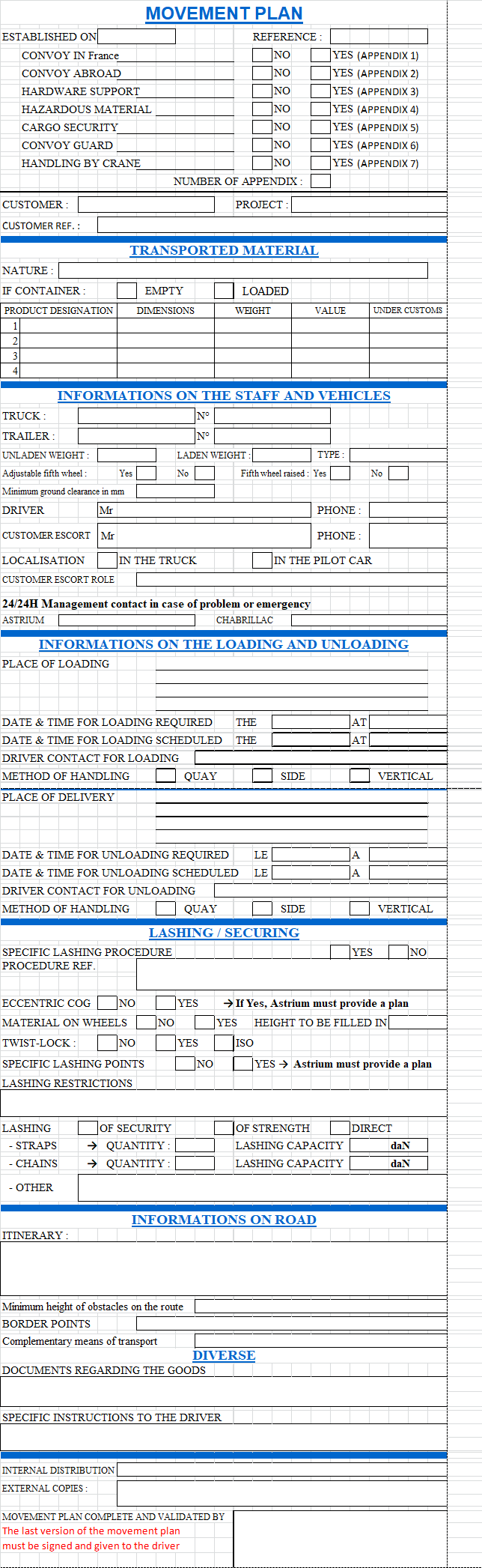 Figure: Example of Movement Plan
ANNEX(informative)Example of a "Consent to transport"
The following is an example of a “Consent to Transport” document.
|
CONSENT TO SHIP
|
Reference:
|
Sheet
|
|
Project:
|
Date:
|
Place:
|
|
Title:
|
Part:
| |
|
PARTICIPANTS (Attendees)
| ||||
|
Name:
|
Position:
|
Signature:
| ||
|



|
Think to provide each time the last version of this document to the escort.
| |||
|
EXPORT CODE NUMBER(S) :
|
|
|||
|
DISTRIBUTION : Participants +
| ||||
Documents Check List
|
|
REF
|
REQUIRED
|
AVAILABLE
|
|
TRANSPORT TECHNICAL SPECIFICATION
|
|
|
|
|
SHIPPING LIST
|
|
|
|
|
MATERIAL SAFETY DATA SHEET (MSDS)
|
|
|
|
|
DESPATCH REQUEST NOTE (DRN)
|
|
|
|
|
MOVEMENT PLAN
|
|
|
|
|
FMEA (RISKS ANALYSIS)
|
|
|
|
|
PRO-FORMA INVOICE
|
|
|
|
|
USER MANUAL
|
|
|
|
|
LOGBOOK
|
|
|
|
|
CONTAINER PREPARATION PROCEDURE
|
|
|
|
|
CONTAINER HANDLING PROCEDURE
|
|
|
|
|
CONTAINER TRANSPORT PROCEDURE
|
|
|
|
|
Ref.
|
Check Item
|
Choice/ Prompt
|
Answer/
|
Responsible/ Action Reference
| |
|
1) Product Detail
|
|
|
|
||
|
(A)
|
Description of equipment to be despatched
|
|
|
|
|
|
(B)
|
Part number of equipment to be despatched
|
|
|
|
|
|
(C)
|
Shipping list of equipment to be despatched
|
|
|
|
|
|
(D)
|
Works Order number of equipment to be despatched
|
|
|
|
|
|
(E)
|
Declared build status
|
|
|
|
|
|
(F)
|
Declared shortages
|
Part numbers
|
N/A
|
|
|
|
2) Packing
|
|
|
|
||
|
(A)
|
Does the shipment require a container
|
|
|
|
|
|
(B)
|
What is the 'class' of container
|
A – F see end of the document
|
|
|
|
|
(C)
|
What is the charge number for transport/labour activities
|
PM discloses
|
Transport:
|
|
|
|
(D)
|
Who has been nominated as: MRE, QA and Operations Director?
|
|
|
|
|
|
(E)
|
When will the product(s) be ready for packing
|
Date and time
|
|
|
|
|
(F)
|
Who is the point of contact for packing
|
Name and contact details
|
|
|
|
|
(G)
|
Which personnel will be involved in packing
|
Names of personnel
|
|
|
|
|
(H)
|
Is any specific equipment required for packing (e.g. cherry picker, crane, fork lift truck). If 'yes', does this equipment require a trained operator
|
List calibrated equipment, confirm it's availability and list names of personnel
|
|
|
|
|
(I)
|
Will there be accessibility from the clean room to the loading area on the above date
|
Has the Link Corridor been booked?
|
|
|
|
|
(J)
|
Have the hazardous items been labelled on the product/MGSE
|
|
|
|
|
|
(K)
|
Has an appropriate, calibrated load cell been identified for use at time of shipment
|
Asset number
|
|
|
|
|
(L)
|
Who is the point of contact for loading the container onto the lorry
|
Name and contact details
|
|
|
|
|
(M)
|
Which personnel will be involved in loading the container onto the lorry
|
Names of personnel
|
|
|
|
|
(N)
|
Will packing/loading be supported appropriately if conducted over a weekend
|
Have personnel been notified?
|
|
|
|
|
3) Shipping Details
|
|
|
|
||
|
(A)
|
Is this a national or international shipment
|
|
|
|
|
|
(B)
|
What is the product's despatch and destination sites
|
|
|
|
|
|
(C)
|
What is the value of the shipment (including GSE) and does the value exceed haulier's liability of insurance
|
List items and respective value
|
|
|
|
|
(D)
|
Have insurers been consulted, if the value of the shipment is greater than 25 Million €
|
|
|
|
|
|
(E)
|
Has international Business Agreement for the haulier been created by the Legal department
|
Yes or No
|
|
|
|
|
(F)
|
Has declaration of value for the goods been issued by the logistics department and sent to the haulier
|
Yes or No
|
|
|
|
|
(G)
|
Export control rating for the product
|
|
|
|
|
|
(H)
|
When is the item required to leave site
|
Date and time
|
|
|
|
|
(I)
|
Who has been nominated as the Transportation Escort and do they have 24hr support from their management in the event of an emergency
|
Name and contact details
|
|
|
|
|
(J)
|
Are there any specific transport requirements
|
List requirements
|
|
|
|
|
(K)
|
Has provisional booking of the shipment been conducted by the Shipping Administrator
|
Booking date
|
|
|
|
|
(L)
|
When will the lorry be on the despatch site
|
Date and time
|
|
|
|
|
(M)
|
When will the shipment arrive at the recipient site
|
Date and time
|
|
|
|
|
(N)
|
Has the recipient (person to physically take receipt of the shipment and unload it) been identified and delivery details agreed
|
Name and Address
|
|
|
|
|
(O)
|
Has the recipient been supplied with the estimated weight of the shipment and confirmed they have sufficient resources to safely unload the shipment
|
|
|
|
|
|
(P)
|
Has confirmation of the booking of the shipment been conducted by the Shipping Administrator
|
Booking date
|
|
|
|
|
(Q)
|
What are the details to be specified on despatch request note (DRN)
|
|
|
|
|
|
(R)
|
Has return transport been arranged for the Transportation Escort
|
Type and details
|
|
|
|
|
(S)
|
Has accommodation been arranged for Transportation Escort
|
Dates and locations
|
|
|
|
|
4) Dimensions
|
|
|
|
||
|
|
Internal
|
|
|
|
|
|
(A)
|
Approximate dimensions of finished item: l, w, h
|
mm
|
|
|
|
|
(B)
|
Required envelop required for packed item x, y, z
|
mm
|
|
|
|
|
(C)
|
Estimated internal dimensions of container I, w, h
|
mm
|
|
|
|
|
(D)
|
Are the estimated internal dimensions adequate for the required envelop
|
|
|
|
|
|
(E)
|
Actual internal dimensions of container l, w, h
|
mm
|
|
|
|
|
(F)
|
Is there a variance between estimated and actual internal dimensions? If yes, raise NCR
|
|
|
|
|
|
|
Weight
|
|
|
|
|
|
(G)
|
Estimated weight of product (minus MGSE)
|
Kg
|
|
|
|
|
(H)
|
Estimated weight of MGSE supporting the product (e.g. trolley, lifting, and bracket)
|
Kg
|
|
|
|
|
(I)
|
Estimated weight of container (unloaded)
|
Kg
|
|
|
|
|
(J)
|
Estimated weight of transport vehicle
|
Kg
|
|
|
|
|
(K)
|
Estimated total weight of load (container + MGSE + product)
|
Kg
|
|
|
|
|
(L)
|
Estimated total weight of shipment (container + MGSE + product + transport vehicle)
|
Kg
|
|
|
|
|
(M)
|
Does the nominated lifting equipment (slings, fork lift truck, crane, load cell) have the capacity to lift this load
|
If 'No', list equipment which will need replacing
|
|
|
|
|
(N)
|
Actual weight of loaded container (container, MGSE and product)
|
Kg
|
|
|
|
|
(O)
|
Is there a variance between estimated and actual weight? If actual is greater, check prior to departure with the transport manager and the haulier if it’s acceptable
|
Yes or No
|
|
|
|
|
|
External
|
|
|
|
|
|
(P)
|
Estimated external container dimensions: l, w, h (in transport configuration)
|
mm
|
|
|
|
|
(Q)
|
Estimated trailer bed height
|
mm (with shipment loaded and air suspension active)
|
Road configuration:
|
|
|
|
(R)
|
Estimated transport height (container height [minus wheels] + trailer height), length (cab + trailer or if greater, cab + container) and width of shipment
|
mm
|
|
|
|
|
(S)
|
Actual external dimensions of container (in transport configuration)
|
mm
|
|
|
|
|
(T)
|
Is there a variance between estimated and actual external dimensions? If actual is greater for width or height, STOP SHIPMENT PROCESS, contact the transport manager and raise NCR
|
NCR reference Decision
|
|
|
|
|
(U)
|
Actual transport height (container height + trailer height), length (cab + trailer or if greater, cab + container) and width of shipment
|
mm
|
|
|
|
|
(V)
|
Is there a variance between estimated and actual dimensions of the transport? If actual is greater for width or height, STOP SHIPMENT PROCESS, contact the transport manager and raise NCR
|
NCR reference
|
|
|
|
|
5) Mechanical Ground Support Equipment
|
|
|
|
||
|
(A)
|
Has the container provider been informed of minimum internal dimensions required
|
Who was informed? Date
|
|
|
|
|
(B)
|
Container provider acknowledged request, confirmed delivery date, identified internal and external dimensions and configuration of container
|
Confirmation date, delivery date, dimensions and configuration
|
|
|
|
|
(C)
|
Availability date of container
|
|
|
|
|
|
(D)
|
Availability date of MGSE for packing
|
|
|
|
|
|
(E)
|
Who will physically check MGSE prior to use and when (ensuring all equipment is in calibration and fit for use, using photographic evidence)
|
Name and contact details
|
|
|
|
|
(F)
|
What MGSE is required for packing and will it be available
|
List items
|
|
|
|
|
(G)
|
Does the MGSE bear 'CE' marks
|
|
|
|
|
|
6) Documents
|
|
|
|
||
|
(A)
|
Has the Work Instruction Sheet (WIS) been issued to cover packing and loading of the product
|
|
|
|
|
|
(B)
|
Where are the instructions recorded to transfer the product into the container
|
Document Ref.
|
|
|
|
|
(C)
|
Is the relevant User Manual available
|
Location
|
|
|
|
|
(D)
|
Has the relevant risk assessment report been signed off as complete
|
Signed off by and when
|
|
|
|
|
(E)
|
Have the relevant MSDS's been issued
|
Date
|
|
|
|
|
(F)
|
Any additional documents to be included in the shipment? If so, who owns them
|
List and name
|
|
|
|
|
(G)
|
Does the shipment have a DoC
|
Location
|
|
|
|
|
(H)
|
Is the C of C suitably endorsed
|
Location
|
|
|
|
|
7) Licences/Permits
|
|
|
|
||
|
(A)
|
Does the shipment contain ITAR controlled goods? If 'yes' identify configured minutes from ITAR review
|
CADM reference
|
|
|
|
|
(B)
|
Have all licenses/permits applicable to the export of the product been received and approved by the Export Compliance Manager
|
|
|
|
|
|
(C)
|
Does the shipment contain any duty relief items (e.g. IPR)
|
Attach list to minutes of meeting
|
|
|
|
|
(E)
|
If the shipment contains dangerous goods, do they conform with the respective regulations/laws for transport on road, sea or air (e.g. ammonia)
|
List items + UN code
|
|
|
|
|
(F)
|
Do we have Marine and Coast Guard Approval (MCA) for shipping heat pipes on the English registered ferry
|
Who obtained the approval
|
|
|
|
|
(G)
|
Do we have Affaires Maritimes approval for using generators on a French registered ferry
|
Who obtained the approval
|
|
|
|
|
8) Quality
|
|
|
|
||
|
(A)
|
Does the item have a requirement for a shock log recorder
|
Who owns it and where is it
|
|
|
|
|
(B)
|
Who will set the shock log recorder. If already set, what evidence is presented to the SRR to confirm this
|
Name and contact details
|
|
|
|
|
(C)
|
Has the FMEA/risk assessment been completed and will any high scores be present at shipment (please identify)
|
Who conducted it and identify high scores
|
|
|
|
|
(D)
|
Has the quality department checks the closure of the FMEA’s actions before the transport?
|
Who?
|
|
|
|
|
9) Haulier
|
|
|
|
||
|
(A)
|
Haulier and driver name
|
|
Haulier:
|
|
|
|
(B)
|
Have special transport requirements been confirmed by haulier
|
Compliance matrix ref.
|
|
|
|
|
(C)
|
Is route/Movement Plan available from the haulier
|
Who received it and date of issue
|
|
|
|
|
(D)
|
Have all potential restrictions on the proposed route been acknowledged and remediated by the haulier? Are they identified in his Movement Plan?
|
Who received confirmation
|
|
|
|
|
(E)
|
Has the haulier confirmed the maximum height, width and length restrictions
|
Who received them and what are the measurements (mm)
|
|
|
|
|
(F)
|
Has haulier checked weather report and is he confident there is minimal risk to travel (high winds etc.)
|
Who received confirmation, where is it stored
|
|
|
|
|
(G)
|
Has it been confirmed by the haulier that the generator will be checked by him regularly during transport
|
Who received confirmation
|
|
|
|
|
(H)
|
Has the accident and emergency plan been agreed between the Flight Hardware Escort and haulier
|
Has it been issued to the SRR
|
|
|
|
|
10) SRR Continuation
|
|
|
|
||
|
(A)
|
Date for SRR to be reconvened (one week prior to shipment and on day of shipment)
|
Dates and location
|
|
|
|
Container Class:
|
Container Class
|
Description
|
|
A
|
Containers for spacecraft or major modules
|
|
B
|
Containers for major sub-assemblies
|
|
C
|
Containers for ultra clean equipment
|
|
D
|
Containers for electronic units and small mechanisms
|
|
E
|
Containers for non-flight equipment including GSE and tooling
|
|
F
|
This covers any containers made/built by despatch department
|
Additional Notes:Shipping List
|
Item Description
|
Net weight (kg)
|
Gross Weight (kg)
|
Length (cm)
|
Width (cm)
|
Height (cm)
|
Value (€)
|
|
Total:
|
|
0
|
|
|
|
0
|
|
Shipment Readiness Review Action Tracking List
| |||||
|
Reference:
|
Date:
|
Sheet 10 of 10
| |||
|
Action No
|
Actionee
|
Description
|
Action Taken
|
Closure Date
|
Status
|
ANNEX(informative)Example of a "Packing, shipping, transportation and delivery checklist"
An example of the checklist for packing, shipping, transportation and delivery is presented in the Figure D-1.
|
Packaging and transport check list
|
Applicable
|
Acceptable
|
Comments / Description
| ||
|
Yes
|
No
|
Yes
|
No
| ||
|
Check Packing procedure for the equipment
|
|
|
|
|
|
|
Check packing is inspected
|
|
|
|
|
|
|
Check container control
| |||||
|
Protections
|
|
|
|
|
|
|
Shock detectors
|
|
|
|
|
|
|
Specific labelling on container
|
|
|
|
|
|
|
Venting for Air transport
|
|
|
|
|
|
|
Specific monitoring
|
|
|
|
|
|
|
Dimensions
|
|
|
|
|
|
|
Weight
|
|
|
|
|
|
|
Labelling for handling and Container marking
|
|
|
|
|
|
|
Constraint for Carrier
| |||||
|
Constraint of dimensions/ weight
|
|
|
|
|
|
|
Constraints of monitoring
|
|
|
|
|
|
|
Any other constraints
|
|
|
|
|
|
|
Check Route and Carrier
| |||||
|
Type of shipment (national/international)
|
|
|
|
|
|
|
Route (direct, multiple)
|
|
|
|
|
|
|
Dedicated transport (no grouped transport)
|
|
|
|
|
|
|
Name of Carrier / approved
|
|
|
|
|
|
|
Driver / approved
|
|
|
|
|
|
|
Escort needed?
|
|
|
|
|
|
|
Check truck/driver control before departure
| |||||
|
Overall Dimensions
|
|
|
|
|
|
|
Container on truck (lashing, protection)
|
|
|
|
|
|
|
Monitoring in place
|
|
|
|
|
|
|
Specific HW running (Air conditioning…)
|
|
|
|
|
|
|
Instructions provided to driver (general, specific…)
|
|
|
|
|
|
|
Emergency phone numbers
|
|
|
|
|
|
|
Shipping documents
|
|
|
|
|
|
Figure: Packing, shipping, transportation and delivery checklist
ANNEX(informative)Deliverable per Review List
Table E-1 presents the reviews at which the different issues of the Storage Plan are expected.
Table: Storage Plan with respected to milestones
|
Document Title |
Review |
DRD Ref. |
|||||||||||
|
MDR |
PRR |
SRR |
PDR |
CDR |
QR |
AR |
ORR |
FRR |
LRR |
CRR |
ELR |
||
|
Storage Plan |
|
|
|
P |
F |
F (see note) |
|
F |
|
|
|
ECSS-Q-ST-20-08C Annex A |
|
|
P-preliminary, C-consolidated, F-final NOTE: The delivery of the final version of the Storage Plan is needed for Pre-storage Review as specified in the clause 5.4.1. This review is not part of the formal reviews defined in ECSS-M-ST-10. But it is to some extend linked to QR or AR and can take place before or after one of these reviews depending on model philosophy (PFM or QM+FM) | |||||||||||||
Bibliography
|
ECSS-S-ST-00
|
ECSS system - Description, implementation and general requirements
|
|
ECSS-Q-ST-60
|
Space product assurance - Electrical, electronic and electromechanical (EEE) components
|
|
ECSS-Q-ST-60-14
|
Space product assurance - Relifing procedure - EEE components
|
|
ECSS-Q-ST-70
|
Space product assurance - Materials, mechanical parts and processes
|