
Space product assurance
Thermal vacuum outgassing test for the screening of space materials
Foreword
This Standard is one of the series of ECSS Standards intended to be applied together for the management, engineering and product assurance in space projects and applications. ECSS is a cooperative effort of the European Space Agency, national space agencies and European industry associations for the purpose of developing and maintaining common standards. Requirements in this Standard are defined in terms of what shall be accomplished, rather than in terms of how to organize and perform the necessary work. This allows existing organizational structures and methods to be applied where they are effective, and for the structures and methods to evolve as necessary without rewriting the standards.
This Standard has been prepared by the Working Group, reviewed by the ECSS Executive Secretariat and approved by the ECSS Technical Authority.
Disclaimer
ECSS does not provide any warranty whatsoever, whether expressed, implied, or statutory, including, but not limited to, any warranty of merchantability or fitness for a particular purpose or any warranty that the contents of the item are error-free. In no respect shall ECSS incur any liability for any damages, including, but not limited to, direct, indirect, special, or consequential damages arising out of, resulting from, or in any way connected to the use of this Standard, whether or not based upon warranty, business agreement, tort, or otherwise; whether or not injury was sustained by persons or property or otherwise; and whether or not loss was sustained from, or arose out of, the results of, the item, or any services that may be provided by ECSS.
Published by: ESA Requirements and Standards Division
ESTEC, P.O. Box 299,
2200 AG Noordwijk
The
Copyright: 2008 © by the European Space Agency for the members of ECSS
Change log
|
ECSS-Q-70-02A
|
First issue
|
|
ECSS-Q-70-02B
|
Never issued
|
|
ECSS-Q-ST-70-02C
|
Second issue
|
Introduction
The kinetics of an outgassing process is influenced by vacuum and temperature conditions.
The method described in this Standard gives reliable data for material screening use exclusively. The nominal temperature for the screening test, as described in this standard is 125 °C. Results from the nominal screening test can be used for the screening of materials that have an operational temperature below 50 °C, especially if they are exposed for an extended period of time (in the order of weeks and above).
Scope
This Standard describes a thermal vacuum test to determine the outgassing screening properties of materials proposed for use in the fabrication of spacecraft and associated equipment, for vacuum facilities used for flight hardware tests and for certain launcher hardware.
This Standard covers the following:
critical design parameters of the test system;
critical test parameters such as temperature, time, pressure;
material sample preparation;
conditioning parameters for samples and collector plates;
presentation of the test data;
acceptance criteria;
certification of test systems and their operators by audits and round robin tests.
The test described in this Standard is applicable for all unmanned spacecraft, launchers, payloads, experiments. The test is also valid for external hardware of inhabited space systems and for hardware to be used in terrestrial vacuum test facilities.
The outgassing and condensation acceptance criteria for a material depend upon the application and location of the material and can be more severe than the standard requirements as given in clause 5.5.3.1.
This standard may be tailored for the specific characteristics and constrains of a space project in conformance with ECSS-S-ST-00.
Normative references
The following normative documents contain provisions which, through reference in this text, constitute provisions of this ECSS Standard. For dated references, subsequent amendments to, or revision of any of these publications do not apply, However, parties to agreements based on this ECSS Standard are encouraged to investigate the possibility of applying the more recent editions of the normative documents indicated below. For undated references, the latest edition of the publication referred to applies.
|
ECSS-S-ST-00-01
|
ECSS system – Glossary of terms
|
|
ECSS-Q-ST-10
|
Space product assurance – Product assurance management
|
|
ECSS-Q-ST-10-09
|
Space product assurance – Nonconformance control system
|
Terms, definitions and abbreviated terms
Terms defined in other standards
For the purpose of this Standard, the terms and definitions from ECSSSST0001 and ECSSQST70 apply.
Terms specific to the present standard
bakeout
activity of increasing the temperature of hardware to accelerate its outgassing rates with the intent of reducing the content of molecular contaminants within the hardware
Bakeout is usually performed in a vacuum environment but may be done in a controlled atmosphere.
cleanroom
room in which the concentration of airborne particles is controlled, and which is constructed and used in a manner to minimize the introduction, generation, and retention of particles inside the room, and in which other relevant parameters, e.g. temperature, humidity, and pressure, are controlled as necessary
[ISO 14644-6]
collected volatile condensable material (CVCM)
quantity of outgassed matter from a test specimen that condenses on a collector maintained at a specific temperature for a specific time
CVCM is expressed as a percentage of the initial specimen mass and is calculated from the condensate mass determined from the difference in mass of the collector plate before and after the test.
outgassing
release of gaseous species from a specimen under high vacuum conditions
quartz crystal microbalance (QCM)
device for measuring small quantities of mass deposited on a quartz crystal using the properties of a crystal oscillator
recovered mass loss (RML)
total mass loss of the specimen itself without the absorbed water
- 1 The following equation holds: RML = TML - WVR.
- 2 The RML is introduced because water is not always seen as a critical contaminant in spacecraft materials.
sticking coefficient
probability that a molecule, colliding with a surface, stays on that surface before thermal reevaporation of that molecule occurs
total mass loss (TML)
total mass loss of material outgassed from a specimen that is maintained at a specific constant temperature and operating pressure for a specified time
TML is calculated from the mass of the specimen as measured before and after the test and is expressed as a percentage of the initial specimen mass.
water vapour regained (WVR)
mass of the water vapour regained by the specimen after the optional reconditioning step
WVR is calculated from the differences in the specimen mass determined after the test for TML and CVCM and again after exposure to atmospheric conditions and 65 % relative humidity at room temperature (22 3) C.
Abbreviated terms
For the purpose of this Standard, the abbreviated terms from ECSS-S-ST-00-01 and the following apply:
|
Abbreviation
|
Meaning
|
|
CVCM
|
collected volatile condensable material
|
|
EOL
|
end-of-life
|
|
IR
|
infrared
|
|
MIC
|
materials identification card
|
|
PTFE
|
polytetrafluorethylene
|
|
QCM
|
quartz crystal microbalance
|
|
RH
|
relative humidity
|
|
RML
|
recovered mass loss
|
|
RT
|
room temperature
|
|
TML
|
total mass loss
|
|
VCM
|
volatile condensable material
|
|
WVR
|
water vapour regained
|
Test overview
Test process description
Figure 41 and Figure 42 are included as a guide to the test procedures. The sequence for the test is given in the flow chart (Figure 42).
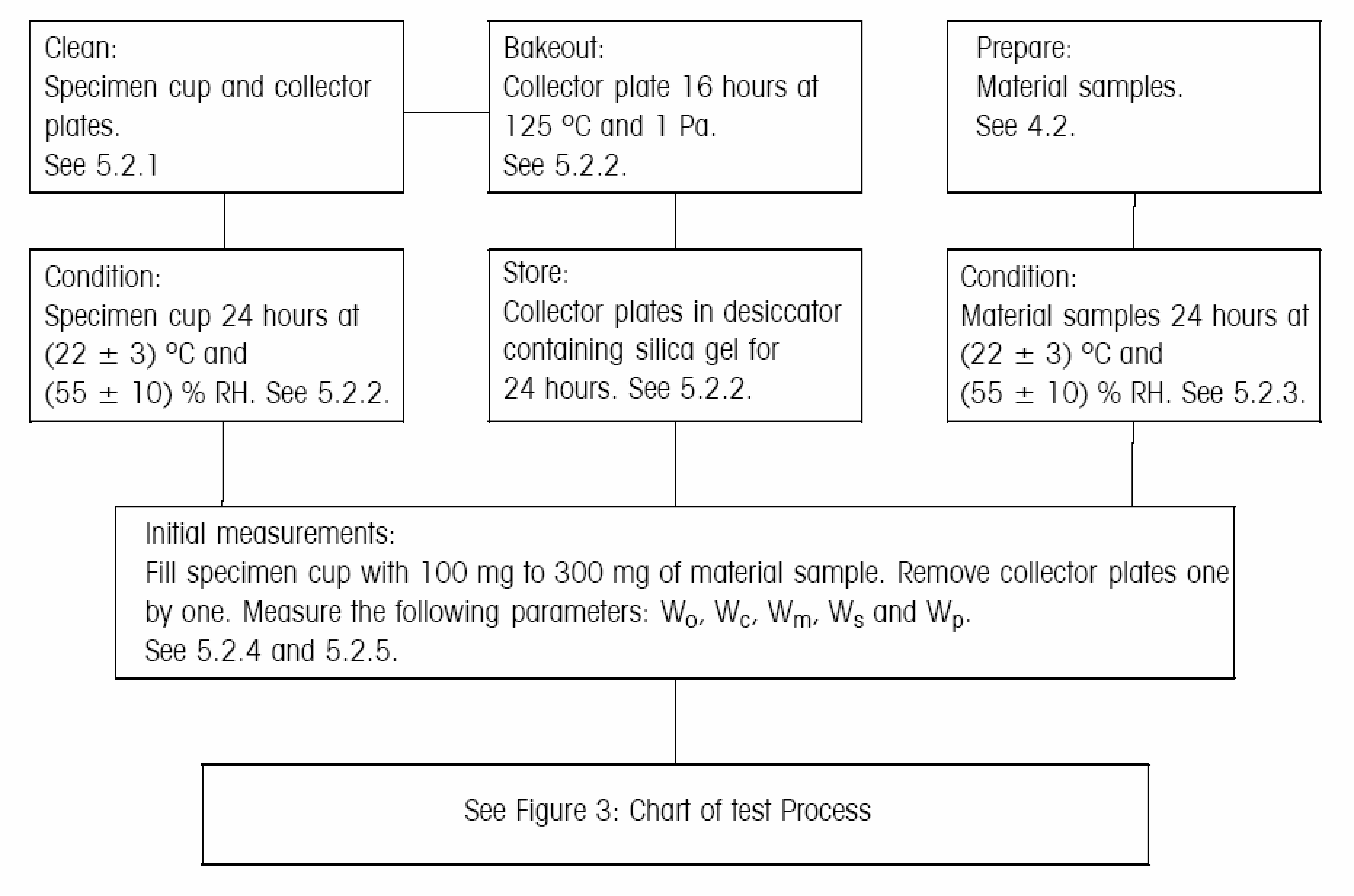 Figure 41: Flow chart of preparation and initial measurements
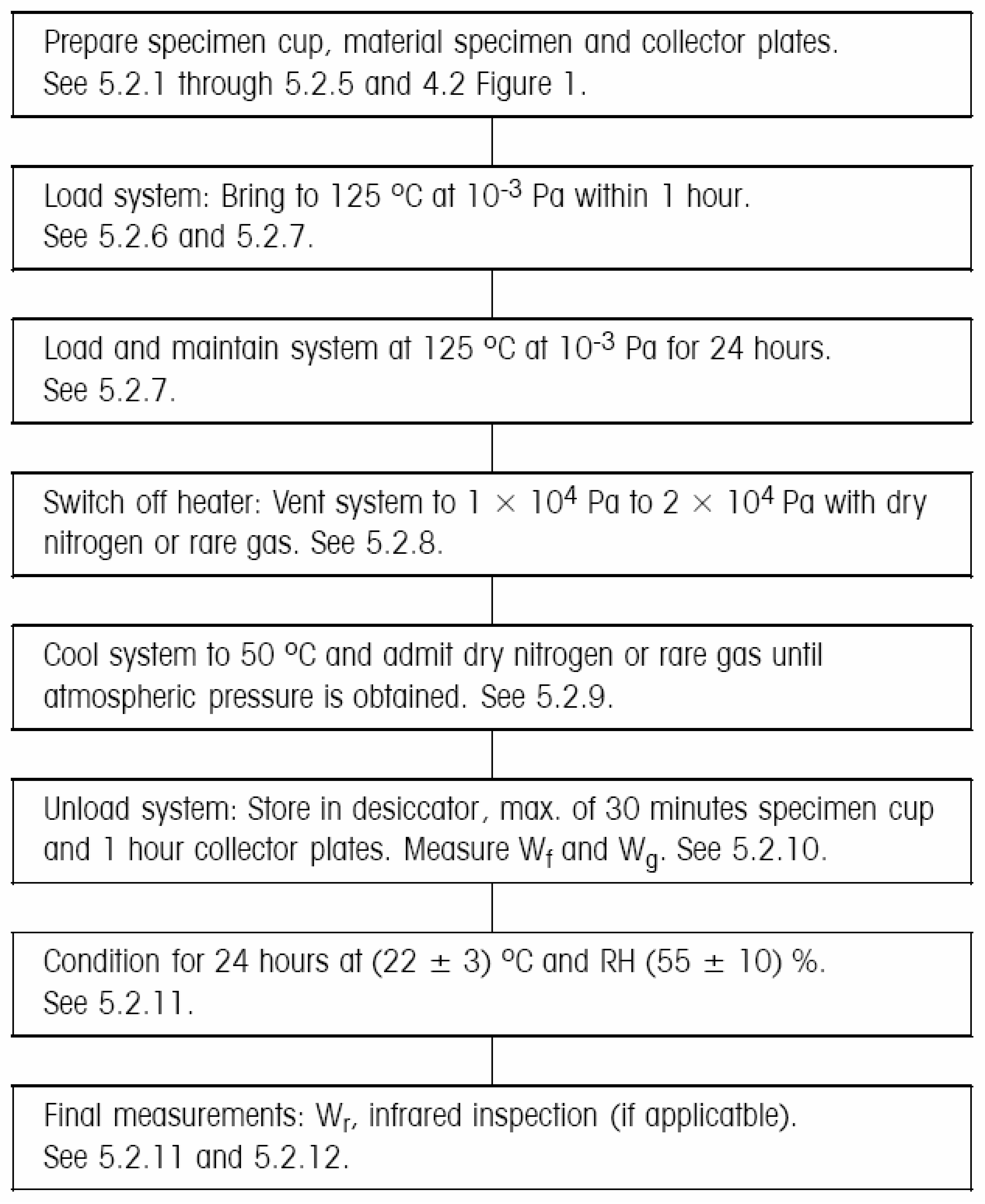 Figure 42: Flow chart of test process
Figure 43: Parameters for sample
Figure 44: Parameters for collector plate
Acceptance limits
The validity of this screening test as a means for determining the suitability of a material for a specific application depends on the environmental conditions during the lifetime of the material as well as the vicinity of critical or sensitive surfaces.
Especially, in cases were the expected maximum temperature of a material during the lifetime is exceeding 50 C for an extended period of time, the use of such material are evaluated further through a test programme, mutually agreed between customer and supplier.
Such programme ensures that the characteristics of the material at the EOL are still within the specified requirements.
Requirements
General requirements
For those materials that are subjected, during the mission, to temperature above 125 °C for short period of time (in the order of hours) or above 50 °C for an extended period of time (in the order of weeks or above), dedicated tests shall be performed at conditions representative of the real application (i.e. higher temperature tests).
Limits for elevated temperature testing shall be specified case by case.
- 1 For example, limits are specified by the requesting project.
- 2 For accelerated tests (i.e. higher temperature testing to take into account long exposures) there can be a limit, above which, the phenomenon is governed by different mechanisms other than those that really interest the material during its on-orbit phase; in such a case, a different kind of test, like a dynamic characterization, can be more pertinent.
The measurement of contamination potential shall be only used in a comparative way and is strictly valid only for collectors at 25 °C with similar sticking coefficients.
The data obtained from this test shall not be used for contamination predictions.
Modelling of the outgassing phenomenon shall be based on dynamic test results only and not on screening results obtained from this Standard.
Preparatory conditions
Hazards, health and safety precautions
The supplier shall take the following health and safety precautions:
- Control and minimize hazards to personnel, equipment and materials.
- Locate items and controls in such a way that personnel are not exposed to hazards such as burns, electric shock, cutting edges, sharp points or toxic atmospheres.
- Provide warning and caution notes in operations, storage, transport, testing, assembly, maintenance and repair instructions and distinctive markings on hazardous items, equipment or facilities for personal protection.
Material samples
Configuration
Preparation
If the material is made up of several items, the sample shall be prepared according to the process specification or manufacturer’s data.
A minimum of 12 g of the material sample shall be prepared.
The reason of this quantity is to provide representative samples (10 g for the initial test and 2 g for subsequent retest if needed).
The material sample shall be made according to the same process parameters as the relevant material to be applied for spacecraft use.
Typical process parameters are curing and baking.
Material cuttings
Three test specimens of each material shall be prepared as follows:
The material cuttings are in general made by the test house concerned.
- For potting materials and bulky adhesives do the following:
- Cast them on a PTFE sheet so that a sample of a few millimetres thick (preferably 2 mm) can be separated from the PTFE after curing;
- Cut the sample into cubes (1,5 mm to 2 mm per side) before testing.
- For thin films, coatings, adhesives and adhesive tapes do the following:
- Apply them to a degreased, dried metal foil of known thickness;
The metal foil can be aluminium and an aluminium foil is typically 16 m (4 103 g/cm2) thick.
* Cut them into strips 10 mm wide;
* Roll up them in such a way that the specimen cup is fit;
- For noncuring adhesives do the following:
- Apply them between thin metal foils.
- Prepare them as specified in 5.2.2.1.2a.2.
- If the substrate is non-metallic, submit a sample of that substrate for separate testing;
- When materials are prepared on substrates, submit a substrate sample with the material sample.
- When primers are applied, test the complete system.
- Cut materials such as wires, cables or sleeves, the smallest dimension of which is less that 1,5 mm, into pieces 10 mm long.
- Test materials containing metal parts without the metal parts or, if this is not possible, state the ratio of metal mass to total mass.
Typical materials with metal parts are electrical wires or connectors.
- Place liquids and greases in a specimen cup and state the ratio of filler mass to total mass if a filler is used.
In some cases, it can be more practical to mix the liquid with a neutral filler powder such as silica before placing it in a cup.
Cleaning
The cleaning and other treatment of the samples shall be the same as that applied to the flight hardware, which the sample is intended to represent, prior to integration into the spacecraft.
The supplier shall test the materials as received without any further cleaning or treatment, unless otherwise specified by the customer.
Handling and storage
Samples shall only be handled with clean nylon or lintfree gloves.
Samples shall be stored in a controlled area, with an ambient temperature of (22 3) C and relative humidity of (55 10) %.
Polyethylene or polypropylene bags or sheets shall be used.
This is to shield coated surfaces from contact.
The polyethylene or polypropylenewrapped workpieces shall be packed in clean, dust and lintfree material.
This is to avoid physical damage.
Limitedlife materials shall be labelled with their shelf lives and dates of manufacture or date of delivery if date of manufacture is not known.
Identification of materials
The customer shall accompany materials submitted for testing by a completed materials identification card in conformance with Annex A.
Facilities
Cleanliness
The supplier shall keep the work area clean from dust as achieved with normal house-keeping.
A cleanroom environment is not necessary.
The supplier shall filter the air used for ventilation.
This is to prevent contamination of the sample.
Environmental conditions
During the conditioning of the prepared material samples, the supplier shall ensure an ambient temperature of (22 3) C with a relative humidity of (55 10) %.
Equipment
Test equipment
The supplier shall use measuring instruments which are capable of monitoring the following items:
- Temperature from 10 C to 130 C with 1 C accuracy.
- Humidity from 40 % to 80 % RH with 1 % RH accuracy.
- Vacuum at 104 Pa with 10 % accuracy.
If requested, the supplier shall use an infrared spectrometer of such a sensitivity that an infrared spectrum of the condensed contaminants in the range 2,5 m to 16 m is obtained.
The supplier shall use a microbalance from 1 106 g to 5 106 g.
The supplier shall use a vacuum oven able to guarantee a maximum pressure of 1 Pa and a temperature of at least 150 C.
Special apparatus
The apparatus shall consist of an insert located in a commontype vacuum system suitably dimensioned with respect to the insert, able to accommodate the necessary feedthroughs.
The insert should consist of a bar (or bars) accommodating a minimum of 6 regularly spaced specimen compartments 16 mm 0,1 mm in diameter and 9,6 mm 0,8 mm deep.
The distance between two adjacent specimen compartments shall be 50 mm 0,8 mm.
The open ends of the specimen compartments shall face the collector plates on the cooling plate(s).
The dimensions of the open ends shall be as follows:
- 6,3 mm 0,1 mm in diameter,
- 12,7 mm 0,3 mm long.
The cooling plate(s) shall be provided with attachments ensuring a good thermal contact with the collector plates.
The distance between the open ends of the specimen compartments and the cooling plate(s) shall be 13,45 mm 0,1 mm.
Cross contamination between different compartments shall be reduced by a separator plate(s) 0,75 mm 0,1 mm thick and perforated with 11,1 mm 0,1 mm diameter holes in front of each specimen compartment.
The separator plate(s) shall be situated between the heater bar(s) and the cooling plate(s) at a distance of 9,65 mm 0,1 mm from the latter.
Standard collectors shall be made of chromiumplated aluminium plates 33,0 mm 0,1 mm in diameter and 0,65 mm 0,1 mm thick.
Standards collectors shall be replaceable by sodiumchloride or germanium collector plates.
Infrared analysis of the condensed materials can be performed when sodium-chloride or germanium collectors are used instead of the standard ones.
Alignment between the hot bar and the cooling plate(s) shall be verified (see Figure 51)
A pressure of 104 Pa shall be reached within one hour with an unloaded system.
The vacuum system shall be checked to be oil free during each test with the aid of three blank collector plates placed at random.
The capability to maintain the heater bars and the cooling plates at temperatures other than those mentioned further in this Standard shall be demonstrated.
It is advisable to make provision for a bakeout, at a temperature of 25 C above the maximum test temperature, of the vacuum system as a means of cleaning it in the event of heavy contamination.
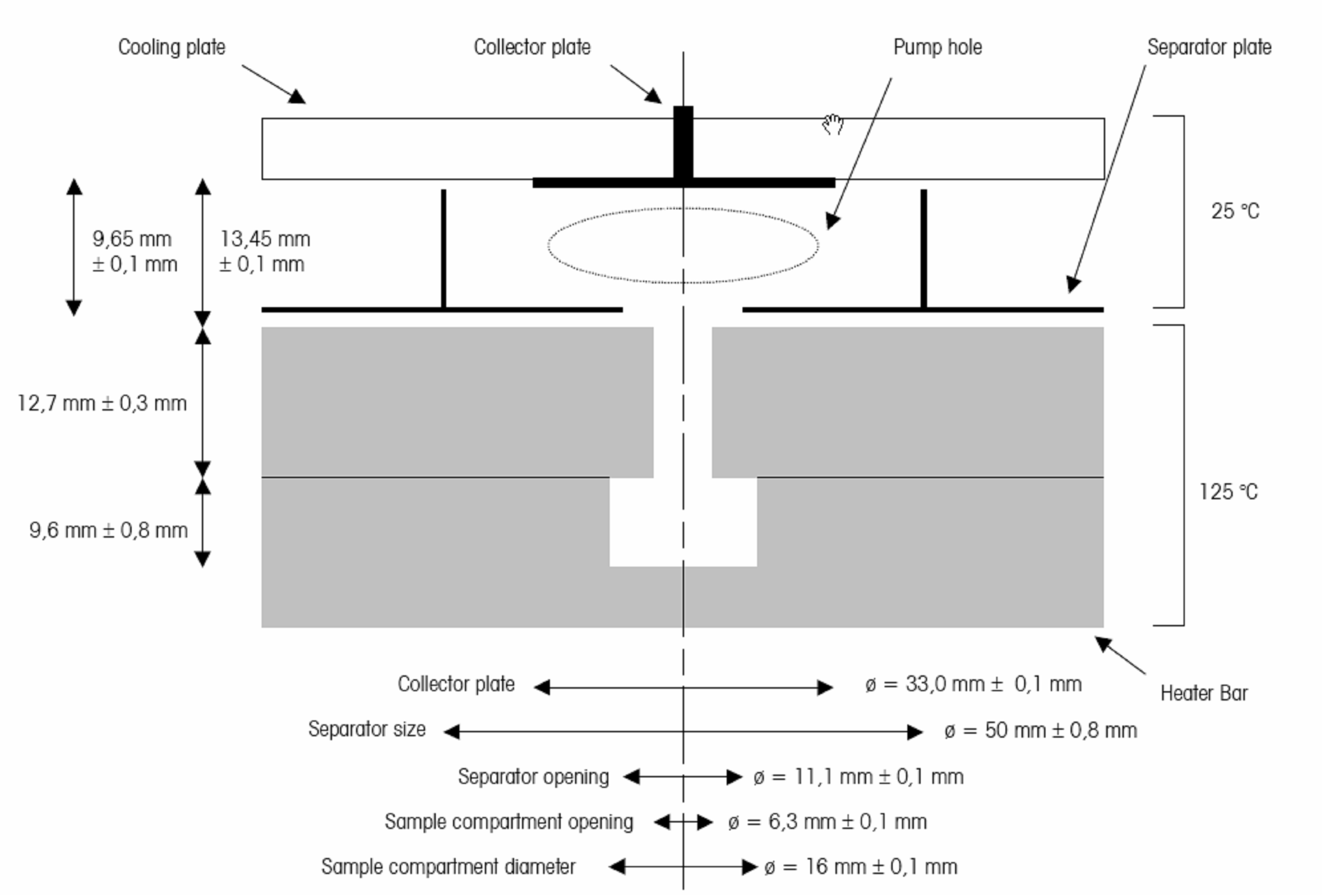 Figure 51: MicroVCM equipment
Test procedure
General requirements
The supplier shall perform the screening test with the minimal and nominal temperature of 125 C.
This outgassing temperature can be raised to a mutual agreed level between the customer and the supplier.
Test process for general spacecraft application
Cleaning of cups and collector plates
The supplier shall clean specimen cups and collector plates with a compatible solvent.
Solvent compatibilities with different materials are provided in ECSS-Q-ST-70-01.
Conditioning of cups and collector plates
The supplier shall condition the specimen cups for at least 24 hours in an environment of (22 3) C and (55 10) % RH.
The supplier shall perform a bakeout of the collector plates for at least 16 hours in a vacuum oven at a pressure lower than 1 Pa, and at a minimum temperature of 125 C.
After the bakeout the supplier shall condition them for a minimum 24 hours in a desiccator containing silica gel.
During the test, the supplier shall expose three specimen cups for each material and three empty specimen cups.
During the test, the supplier shall place collector plates in front of each cup.
The supplier shall use the three collector plates facing the empty cups as blanks.
This is to verify the cleanliness of the equipment.
The supplier shall incorporate corrections based on the blanks in the actual mass loss calculations.
Conditioning of samples
The supplier shall prepare material specimens in the manner laid down in clause 5.2.
The supplier shall condition them for at least 24 hours at (22 3) C and (55 10) % RH.
Weighing of samples
The supplier shall fill the preweighed specimen cups with 100 mg to 300 mg of specimen (substrate not included).
For low density foams a sample mass of 100 mg can be obtained by choosing a sample cup of bigger size, or compressing the foam into the sample cup.
The supplier shall perform weighing on a microbalance (see 5.2.4.1c.) located in a room conditioned at (22 3) C and (55 10) % RH just before the loading of the test system.
Weighing of collector plates
The supplier shall weigh the collector plates just before the loading of the test system.
This is done by taking them from the desiccator one by one.
Loading of system
The supplier shall load the test system with:
- the specimen cups,
- the blank cups,
- the blank collectors,
- the two chromiumplated collectors, and
- one infraredtransparent collector or three chromiumplated collectors per material.
Pump-down and heating
The supplier shall carry out the pump down of the test system in the following procedure:
- at 103 Pa bring the heater bar(s) to the specified temperature within one hour;
- control the cooling plate(s) at 25 C;
- maintain these temperatures for a period of 24 hours following the instant at which the heater bar(s) reach(es) the specified temperature. The supplier shall ensure that the specified temperature does not exceed the maximum bakeout temperature.
End of test
After 24hour exposure, the supplier shall switch off the heaters
The supplier shall vent the system up to 1 104 Pa to 2 104 Pa with dry nitrogen or rare gas.
The supplier shall continue cooling until the end of the test.
Gas inlet
When the temperature of the heater bar(s) has fallen to 50 C, the supplier shall admit dry nitrogen or rare gas up to atmospheric pressure.
The cooling normally takes (90 - 120) minutes.
Unloading of system
The supplier shall unload the system as soon as possible.
The supplier shall keep the specimen cups in a desiccator for not more than 30 minutes.
The supplier shall keep the collector plates in a desiccator for one hour.
The supplier shall weigh the specimen cups and collector plates.
This is done by taking them from the desiccator one by one and returned immediately thereafter.
Storage of collector plates
The supplier shall store the specimen cups with material samples in a room, at an ambient temperature of (22 3) C and a relative humidity of (55 10) %, for 24 hours.
The supplier shall reweigh them afterwards.
Infrared analyses
The supplier shall examine the infraredtransparent collector plates in the transmission mode, with the aid of an infrared spectrometer of such a sensitivity so that an IR spectrum of the condensed contaminants is obtained.
- 1 See also clause 5.3.2.14.
- 2 In special cases the standard metal collector plates can be analysed by infrared reflection techniques, however, no quantitative information can be expected from this reflection method. The contaminants can also be washed from the metal collector plates and the washing liquid can be used for further analyses.
Cleaning of system
After each test, the supplier shall clean the heater bar(s), condensor plate(s) and screen(s) of the equipment with a compatible volatile solvent.
The supplier shall perform baking at 25 C above the specified test temperature if the blank collectors indicate a mass increase > 30 g during the previous test.
It is a good practice to bake the system once every four months.
Improved sensitivity of the CVCM measurements
In cases where the CVCM outgassing requirements are more stringent than the standard detection limits, a quartz crystal microbalance should be installed as a fourth collector plate.
- 1 See clause 5.5.2.
- 2 The infrared transmission data (see 5.3.2.12) can also be used for equivalent mass determination as the intensities of the infrared absorption bands are related to the mass of the contaminants by the law of LambertBeer.
Reporting of test data
The supplier shall fill in all data obtained during an outgassing test in a micro VCM worksheet form in conformance with Annex B.
The supplier shall report the results in a micro VCM datasheet form in conformance with Annex C.
The outgassing data are given down to 0,01 % for normal tests, and for tests with increased sensitivity these figures can be one order of magnitude lower.
Acceptance limits
General requirements
The validity of this screening test as a means for determining the suitability of a material for a specific application shall depend on the environmental conditions during the lifetime of the material as well as the vicinity of critical or sensitive surfaces.
When the expected maximum temperature of a material during the lifetime is exceeding 125 °C for short period of time (in the order of hours) or is exceeding 50 C for an extended period of time (in the order of week or above), the use of such material shall be evaluated further through a test programme and mutually agreed between the customer and the supplier.
The test programme shall ensure that the characteristics of the material at the EOL are still within the specified limits.
Acceptance limits for a retest of the material
The supplier shall test a material threefold.
The average data of the three values shall be within the limits as given in 5.5.2d.
In case these limits are exceeded, the supplier shall perform a retest of the material.
The variation of the outgassing data can be caused by the material variance or by the variance of the test parameters.
The maximum values for one standard deviation () with respect to the mean values derived from the three specimens of each material tested shall be as follows:
- < 1/10 of the mean values of TML and RML, with a minimum value of 0,05 %;
- < 1/5 of the mean value of CVCM, with a minimum value of 0,03 %. The supplier should have a material sample of > 1 g in order to be able to repeat a test.
For protection of samples, see clause 5.7.4.2.
Acceptance limits for application of a material
General
As a minimum, the outgassing screening parameters for a material selection shall be as follows:
- RML < 1,0 %;
- CVCM < 0,10 %.
- 1 For materials used in the fabrication of optical devices, or in their vicinity, the acceptance limits can be more stringent than those stated below.
- 2 It is nowadays becoming standard practice to bake critical hardware (such as structural parts, harness, electronic boxes and thermal blankets) to the highest permissible temperature for a few days in order to remove residual contaminants, process contaminants and handling contaminants.
- 3 In this respect it is of interest to test materials after such baking as is expected for the hardware. Also, infrared inspection can be invoked if considered necessary (see clause 5.3.2.12).
Corrective actions for high outgassing materials
In case the material outgassing is higher than the general requirements in 5.5.3.1, corrective actions shall be taken.
Corrective actions can be relaxed for the following conditions:
- if very small mass is used;
- if the location of the material is far away from the sensitive items;
- if the high outgassing material is shielded;
- if the outgassing species (e.g. water) are not seen as a critical containment.
Water absorption of materials
The customer should accept materials with TML > 1,0 % and RML < 1,0 % when the following conditions are met:
- when no equipment at a temperature below 100 C is involved;
- when the water desorption is fast (e.g. in the case of polyimide films and polyurethane paints);
- when no high voltage equipment is involved;
- when dry gas purging controls the water reabsorption during ground life up to launch.
- 1 In most cases the water absorption of materials is not harmful with respect to contamination.
- 2 Water absorption of materials is included in the measured TML. The TML data for water absorbing materials such as polyamides, polyimides and polyurethanes, is often above 1,0 %. Water absorption is in most cases reversible and can be controlled by purging of critical hardware with dry gases.
- 3 The measuring method as described in this Standard takes water reabsorption into account, as both the TML and the RML are measured.
- 4 The RML is basically the TML value that does not include reabsorbed water or RML = TML - WVR).
More stringent outgassing requirements
The customer shall make the limits defined in clause 5.5.3.1 more stringent if the materials concerned are used in critical areas.
The use of materials that are deemed acceptable according to the limits stated above does not ensure that the spacecraft system or component remains uncontaminated.
The customer shall use subsequent functional, development and qualification test.
This is done to ensure that the material’s performance continues to be satisfactory.
In case water absorption (or desorption) of materials can result in contamination problems, the customer shall evaluate the outgassing requirements for materials on a case by case basis.
For example, in case of using cryogenic equipment.
For cases where the CVCM requirements are lower than 0,1 % the supplier shall calculate that the CVCM detection limit of the standard MicroVCM test is around 0,02 %.
- 1 This is because of both material variances and measuring errors.
- 2 For example, cases like certain optics.
For cases where CVCM < 0,05 % is required, the supplier shall implement other types of CVCM measurements.
For Improved sensitivity of CVCM measurements, see clause 5.3.2.14.
Quality assurance
Data
The supplier shall provide the test report in conformance with Annex D.
The supplier shall provide the certificate of conformity in conformance with Annex E.
The supplier shall retain the quality records for at least ten years or in accordance with project business agreement requirements.
Example of such quality records are logbooks.
The quality records shall be composed of the following:
- The MIC
- The Micro-VCM worksheet
- The Micro-VCM datasheet
- The test report
- The certificate of conformity.
Calibration
The supplier shall calibrate any measuring equipment to traceable reference standards.
The supplier shall record any suspected or actual equipment failure as a project nonconformance report in conformance with ECSS-Q-ST-10-09.
This is to ensure that previous results are examined to ascertain whether or not reinspection or retesting is necessary.
Audit of the Micro-VCM test apparatus
General
The standard audit shall be performed according to ECSS-Q-ST-10, clause 5.2.3.
- 1 The main purpose of this audit is to ensure the validity of test results by comparison of the test data on identical materials by different test houses.
- 2 The material outgassing data from test houses for the projects of the customer, obtained in the manner laid down in this Standard, are only accepted for the projects of the customer if the test house is certified to perform the MicroVCM test.
- 3 The auditing exercise can be part of a “Round Robin” test on different apparatus of selected test houses.
Initial audit of the system (acceptance)
General requirement
The system shall be audited after it has been built.
The audit is necessary before the system can be accepted for running qualification or quality control tests on materials for use in customerprojects.
Inspection of apparatus and associated equipment
The customer shall inspect the following parts of the MicroVCM apparatus:
- internal dimensions, view factor (sample compartment to collector plates) and cross contamination protection;
- pumping system and associated monitoring equipment;
- temperature regulation of sample and collector plates and associated monitoring equipment;
- thermal contact of the temperature sensors. The customer shall inspect the following associated equipment:
- precision balance (reading to 1 g);
- temperature and relative humidity in the balance room is controlled to obtain the required accuracy and reproducibility;
- room for sample pre and post conditioning;
- vacuum oven for bakeout of collector plates;
- clean sample preparation room;
- infrared apparatus (optional).
Performing a blank test
The supplier shall perform the blank test with identical conditions and procedures as the normal MicroVCM test as described in clause 5.3.2, but with empty sample cups.
The purpose of this test is to ensure the apparatus is performing correctly and no selfcontamination occurs.
The supplier shall calculate the results for TML, RML and CVCM (theoretically all zero) as for a normal VCMtest.
The results shall be within the tolerance as specified for a normal MicroVCM test, i.e. a mass variation of less than 30 g on the collector plates.
Performing an actual test
Seven samples for this test shall be selected and supplied.
The supplier shall perform the actual test with identical conditions and procedure as the normal Micro-VCMtest as described in clause 5.3.2.
The test shall be performed at the same time by all participants in case of “Round Robin”.
The acceptance limits shall be within the following limits:
- for CVCM/TML/RML values > 0,2 % within 20 % of the average value of all participants;
- for CVCM/TML/RML values < 0,2 % within 0,05 % of the average value of all participants.
Nonconformance
For nonconformances ECSS-Q-ST-10-09 shall apply.
Reporting of audit findings
The customer shall deliver a written report of the initial audit including the certificate of conformity, in conformance with Annex E within six weeks after the end of the audit provided no nonconformance are detected.
The supplier shall renew the certificate of conformity every three years after a successful audit.
Annual regular review (maintenance) of the system
Inspection of apparatus and associated equipment
Based on the initial test, as described in clause 5.7.2.2, the customer shall perform a review of any modifications made to the test facility or apparatus.
Mutual comparability evaluation (testing)
The customer shall select and supply the seven samples for the test.
The supplier shall perform this test with identical conditions and procedures as the normal MicroVCM test as described in clause 5.3.2.
All suppliers involved in projects of the customer shall run the test.
Nonconformance
For nonconformances ECSS-Q-ST-10-09 shall apply.
- 1 This can lead to perform a further test in accordance with clause 5.7.2.4.
- 2 For example, a nonconformance with the applicable audit specification of the customer or the acceptable limits of the test results.
Reporting of audit findings
The customer shall deliver a written report of the result of the regular review to all participants within six weeks after the end of the regular review or evaluation testing.
Special review
General
The supplier shall report all modifications of the apparatus or associated equipment.
The customer shall audit before using the modified system if deemed necessary.
For major modifications, the supplier shall retest the apparatus as described in clause 5.7.2.
Preservation of samples
The supplier shall preserve a quantity of untested material, sufficient for a second MicroVCM test for a period of not less than one year.
This is done so that material is available for submittal to the customer in case of request by the customer’s project product assurance representative or department.
ANNEX(normative) Materials identification card (MIC) - DRD
DRD identification
Requirement identification and source document
This DRD is called from ECSS-Q-ST-70-02, requirement 5.2.2.4a.
Purpose and objective
The purpose of this document is to uniquely identify and to provide the properties of the material under testing.
Expected response
Scope and content
Description and history of sample
The materials identification card shall contain the following information:
- Trade name and number
- Manufacturer
- Type of product
- Chemical nature
- Processing details. Sample batch
The materials identification card shall contain the following information:
- Batch number
- Sample quantity
- Preparation date
- Prepared by. Material and substrate
The materials identification card shall contain the following information:
- Material density
- Substrate density
- Substrate material. Outgassing screening data
The materials identification card shall contain the following outgassing screening properties:
- TML
- RML
- CVCM. Test reference number
The materials identification card shall contain a test reference number.
Special remarks
An example of a materials identification card is shown in Figure A-1.
|
Materials identification card
| |||
|
Description and history of samplea. Trade name + numberb. Manufacturerc. Type of productd. Chemical naturee. Processing details:
|
a. Aeroglaze Z306 + Pyrolac P123
|
b. Lord Corporation / Akzo
| |
|
c. Paint, conductive, black,Primer yellow
|
d. Polyurethane / Epoxy
| ||
|
e. Mix ratio Primer P123: Hardener = 100 : 25 Paint S125 : Z306 : MEK is 50 : 100 : 60
| |||
|
Batch number
|
1108447
|
Material density
|
Unknown
|
|
Contractor/Experimenter
|
Contractor
|
Project/Cost code
|
XMM - Project
|
|
ESTEC PA manager or originator name and signature
|
PA name
| ||
|
Application
|
Coating optical equipment
| ||
|
Test specification number
|
ECSS-Q-ST-70-02
|
Quality control sample or evaluation sample
|
Evaluation
|
|
For materials and processes division use
|
Report number:
|
TML = 1,55 %RML = 0,47 %CVCM = 0,00 % Accept Reject | |
Figure: Example of filled MIC
ANNEX(normative) Micro-VCM worksheet - DRD
DRD identification
Requirement identification and source document
This DRD is called from ECSS-Q-ST-70-02, requirement 5.4a.
Purpose and objective
The purpose of this document is to gather all the measurements necessary to be collected or calculated during micro-VCM testing.
Expected response
Scope and content
Unique sample identification
The Micro-VCM worksheet shall contain a unique sample identification.
Material identification
The Micro-VCM worksheet shall contain the material identification.
Weights
The Micro-VCM worksheet shall contain the following weights data:
- Mass of specimen cup: Wc
- Total specimen mass just after test: Wf
- Final mass of collector plates after test: Wg
- Mass of material before test: Wm
Wm = Wo – Wc – Ws
- Total specimen mass before the test: Wo
The total specimen mass (Wo) includes the mass of the material, the mass of the cup and the mass pf the substrate.
- Initial mass of collector plates before test: Wp
- Total specimen mass after test and after 24 hours and a final conditioning at (22 3) C and (55 10) % RH environment: Wr
- Mass of substrate, determined by weighing or by calculation from density and surface area: Ws. Outgassing screening data
The Micro-VCM worksheet shall contain the following outgassing screening properties:
- TML
- RML
- WCR
- CVCM.
Table B-1 lists the calculations needed to establish these values.
Table: Outgassing screening properties
|
Term
|
Calculations
|
Remarks
|
|
TML %
|

|

|
|
CVCM %
|

|
|
|
RML %
|

|
Wr is measured on completion of post conditioning
|
|
WVR %
|

|
|
Test reference number
The Micro-VCM worksheet shall contain a test reference number.
IR date
The Micro-VCM worksheet shall contain the IR date.
Special remarks
An example of a Micro-VCM worksheet is shown in Figure B-1.
|
Item no.
|
Commercial identification or standard designation
|
Wc
|
Wo
|
Ws
|
Wm
|
Wf
|
Wr
|
Wp
|
Wg
|
TML
|
RML
|
WCR
|
CVCM
|
Test reference no.
|
IR date
|
Observations
|
|
1
|
Honeycomb
|
|
|
|
|
|
|
|
|
|
|
|
|
|
|
|
|
|
|
|
|
|
|
|
average standard
|
|
|
|
|
|
|
|
||
|
2
|
Aeroglaze Z306 +
|
174263
|
507690
|
89750
|
243677
|
503938
|
506522
|
367771
|
367783
|
1,54
|
0,48
|
1,06
|
0,00
|
E 448
|
None
|
Black paint with yellow primer
|
|
|
|
|
|
|
|
|
|
|
average standard
|
1,550,05
|
0,470,04
|
1,080,02
|
0,010,01
|
|
|
|
|
3
|
Aeroglaze Z306 +Pyrolac P123
|
|
|
|
|
|
|
|
|
|
|
|
|
|
|
|
|
|
|
|
|
|
|
|
|
|
average standard
|
|
|
|
|
|
|
|
|
4
|
Eccosil 4952
|
|
|
|
|
|
|
|
|
|
|
|
|
|
|
|
|
|
|
|
|
|
|
|
|
|
average standard
|
|
|
|
|
|
|
|
|
5
|
Araldite AV100/HV100
|
|
|
|
|
|
|
|
|
|
|
|
|
|
|
|
|
|
|
|
|
|
|
|
|
|
average standard
|
|
|
|
|
|
|
|
|
6
|
Electrodag 501
|
|
|
|
|
|
|
|
|
|
|
|
|
|
|
|
|
|
|
|
|
|
|
|
|
|
average standard
|
|
|
|
|
|
|
|
|
7
|
Solitane 113
|
|
|
|
|
|
|
|
|
|
|
|
|
|
|
|
|
|
|
|
|
|
|
|
|
|
average standard
|
|
|
|
|
|
|
|
Figure: Example of filled in Micro-VCM worksheet
ANNEX(normative) Micro-VCM datasheet - DRD
DRD identification
Requirement identification and source document
This DRD is called form ECSS-Q-ST-70-02 requirement 5.4b.
Purpose and objective
The purpose of this document is to collect the results of the Micro-VCM test with reference to its unique material identification card
Expected response
Scope and content
Unique sample identification
The Micro-VCM datasheet shall contain an unique sample identification.
Material identification
The Micro-VCM datasheet shall include the material identification.
The Micro-VCM datasheet shall contain a reference to the relevant materials identification card.
For the MIC, see Annex A.
Chemical nature
The Micro-VCM datasheet shall identify the chemical nature of the material.
Product type
The Micro-VCM datasheet shall contain the product type.
Manufacturer
The Micro-VCM datasheet shall identify the manufacturer’s name.
Summary process parameters
The Micro-VCM datasheet shall include a summary of the process parameters.
Use and location
The Micro-VCM datasheet shall describe the use and location of the materials in the spacecraft.
User code
The Micro-VCM datasheet shall contain the user code.
Outgassing screening data
The Micro-VCM datasheet shall contain the following outgassing screening properties:
- TML
- RML
- WCR
- CVCM.
Table B-1 lists the calculations needed to establish these values.
Test reference number
The Micro-VCM datasheet shall contain a test reference number.
IR data results
The Micro-VCM datasheet shall contain the IR data results.
Special remarks
An example of a Micro-VCM datasheet is shown in Figure C-1.
|
Item no.
|
Commercial identification or standard designation
|
Chemical nature
|
Product type
|
Procurement information
|
Summary of process parameters
|
Use and location
|
User code
|
TML
|
RML
|
WVR
|
CVCM
|
Testreference no.
|
IR-data results
|
Observations |
|
|
ISO-1043
|
|
manufacturer/ supplierprocurement spec.
|
|
|
contractor project
|
|
|||||||
|
1
|
Honeycomb
|
EP/Al
|
honeycomb
|
Casa
|
Spec Ca-423-95A
|
structure
|
Meris-C3
|
|
|
|
|
|
|
|
|
2
|
Aeroglaze Z306 + Pyrolac P123
|
PUR/EP
|
paint black/ primer yellow
|
Lord/Akzo
|
Cure 24 at RT + 6 d at 65 C
|
optical equipment
|
XMM
|
1,55
|
0,47
|
1,08
|
0,00
|
E 448
|
None
|
|
|
3
|
Aeroglaze Z306 +
|
PUR/EP
|
paint black/ primer yellow
|
Lord/Akzo
|
Cure 24 at RT + 6 d at 65 C
|
battery PF3/a12
|
Mipas-A5
|
|
|
|
|
|
|
|
|
4
|
Eccosil4952
|
SI
|
potting
|
Emerson & Cuming
|
Cure 7 d at RT + 24h at 45 C
|
connector
|
EURECA-
|
|
|
|
|
|
|
|
|
5
|
Araldite AV100/HV100
|
EP
|
adhesive
|
Ciba Geigy
|
Cure 4 h at 60 C
|
insert
|
ISO-SS-Fok
|
|
|
|
|
|
|
|
|
6
|
Electrodag 501
|
Fluoro
|
paint-cond. black
|
Acheson
|
as received
|
|
|
|
|
|
|
|
|
|
|
7
|
Solithane 113
|
PUR
|
potting
|
Thiokol
|
as received
|
|
Silex
|
|
|
|
|
|
|
|
Figure: Example of filled in Micro-VCM datasheet
ANNEX(normative) Thermal vacuum outgassing test report - DRD
DRD identification
Requirement identification and source document
This DRD is called from ECSS-Q-ST-70-02, requirement 5.6.1.a.
Purpose and objective
The purpose of this document is to describe the contents of the thermal vacuum outgassing test report to document the thermal vacuum outgassing test for screening of space materials.
Expected response
Scope and content
Specific mass of the finished product
The report shall contain specific mass of the finished product:
- per cm3 for bulk solid;
- per cm2 for coatings and thin layers;
- per cm for wires and threads. Density of substrate
The report shall contain density of substrate in g/cm2 or ratio of material mass to total mass of material plus substrate.
Identification of test specimen
The report shall contain identification of size, area and mass of test specimen, together with an indication of whether the sample was of the substrate or sandwich type.
Nature of the collector plates
The report shall contain the nature of the collector plates.
Main wavelength peaks
The report shall contain the main wavelength peaks with their wavelength value if an infrared spectrum is obtained of the condensed material.
Noticeable incidents
The report shall contain any noticeable incident observed during the test.
Outgassing screening data
The report shall contain the following outgassing screening properties:
- TML
- RML
- WCR
- CVCM.
Table B-1 lists the calculations needed to establish these values.
Failure mode
The report shall contain details of failure mode.
Identification of material
The report shall contain the identification of the material, in conformance with 5.2.2.4
Special remarks
None.
ANNEX(normative) Certificate of conformity for Micro-VCM - DRD
DRD identification
Requirement identification and source document
This DRD is called from ECSS-Q-ST-70-02B, requirement 5.6.1b.
Purpose and objective
The purpose of this document is to report the audit findings and to provide to provide a declaration of the auditing authority stating that the supplier of micro VCM test data complies with all the ECSS-Q-ST-70-02 requirements and the audit requirements of ECSS-Q-ST-20.
Expected response
Scope and content
The certificate of conformity shall contain the following audit criteria according to the relevant clauses of ECSSQST7002:
- Data recording ( in conformance with clause 5.6.1)
- Nonconformance
- Calibration ( in conformance with clause 5.6.2)
- Traceability
- Inspection of apparatus and associated equipment ( in conformance with clause 5.7.2.2)
- Performing a blank test ( in conformance with clause 5.7.2.3)
- Performing an actual test ( in conformance with clause 5.7.2.4)
Special remarks
An example of a certificate of conformity is shown in Figure E-1.
|
Certificate of conformity
| ||
|
This certificate of conformity states that the customer declares that the supplier of Micro-VCM data complies with the requirements in ECSSQST-7002 and the audit requirements in ECSSQST20.
| ||
|
Customer (incl. Auditor[s])
|
*
| |
|
Supplier (incl. Operator[s])
|
*
| |
|
Audit criteria according relevant clauses of ECSSQST7002
|
*
| |
|
1. Data recording
|
*
| |
|
2. Nonconformance
|
*
| |
|
3. Calibration
|
*
| |
|
4. Traceability
|
*
| |
|
5. Inspection of apparatus and associated equipment
|
*
| |
|
6. Performing a blank test
|
*
| |
|
7. Performing an actual test
|
*
| |
|
The audit took place on *__________and the certification is valid from *__________ to *__________
| ||
|
This certificate is granted by: **
| ||
|
* fill in** fill in customer and date
| ||
Figure: Example of a certificate of conformity for Micro-VCM
Bibliography
|
ECSS-S-ST-00
|
ECSS system – Description, implementation and general requirements
|